Stimulating blood vessel formation with magnets

TSUKUBA, Japan, Jul 22, 2021 – (ACN Newswire) – Magnetic field can be used to stimulate blood vessel growth, according to a study published in the journal Science and Technology of Advanced Materials. The findings, by researchers at the Tecnico Lisboa and NOVA School of Science and Technology in Portugal, could lead to new treatments for cancers and help regenerate tissues that have lost their blood supply.


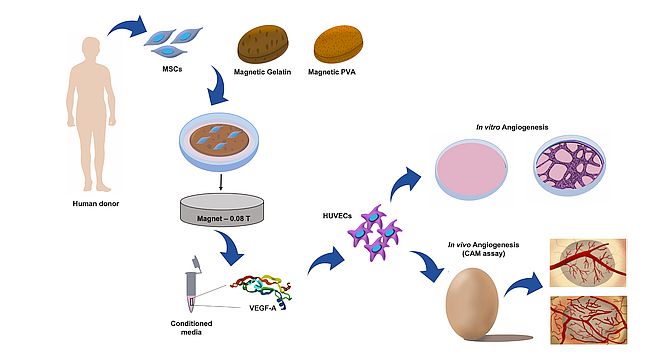
Human-donated mesenchymal stromal cells were placed on PVA or gelatin hydrogels containing iron oxide nanoparticles. Applying a magnetic field to the gelatin hydrogel triggered the release of VEGF-A. This was used to treat endothelial cells, stimulating blood vessel formation.


"Researchers have found it challenging to develop functional, vascularized tissue that can be implanted or used to regenerate damaged blood vessels," says Frederico Ferreira, a bioengineer at Tecnico Lisboa's Institute for Biosciences and Bioengineering. "We developed a promising cell therapy alternative that can non-invasively stimulate blood vessel formation or regeneration through the application of an external low-intensity magnetic field."

The researchers worked with human mesenchymal stromal cells from bone marrow. These cells can change into different cell types, and also secrete a protein called VEGF-A that stimulates blood vessel formation.

Ana Carina Manjua and Carla Portugal, at the Research Centre LAQV at the NOVA School of Science and Technology, developed two hydrogel supports, made from polyvinyl alcohol (PVA) or gelatin, both containing iron oxide nanoparticles. Cells were cultured on the hydrogels and exposed to a low-intensity magnetic field for 24 hours.

The cells on the PVA hydrogel produced less VEGF-A after the magnetic treatment. But the cells on the gelatin hydrogel produced more. Subsequent lab tests showed that this VEGF-A rich extracts, taken from the cultures on magnet-stimulated gelatin hydrogel, improved the ability of human vascular endothelial cells to sprout into branching blood vessel networks.

Endothelial cells were then placed onto a culture dish with a gap separating them. The conditioned media from magnet-treated mesenchymal stromal cells from the gelatin hydrogel were added to the endothelial cells, moving to close the gap between them in 20 hours. This was significantly faster than the 30 hours they needed when they had not received magnetic treatment. Placing a magnet directly below the dish triggered the mesenchymal stromal cells to close the gap in just four hours.

Finally, VEGF-A extracts produced by magnet-treated mesenchymal stromal cells on gelatin increased blood vessel formation in a chick embryo, although further research is needed to confirm these results.

More work is needed to understand what happens at the molecular level when a magnetic field is applied to the cells. But the researchers say gelatin hydrogels containing iron oxide nanoparticles and mesenchymal stromal cells could one day be applied to damaged blood vessels and then exposed to a short magnetic treatment to heal them.

The team suggests that magnet-treated cells on PVA, which produce less of the growth factor, could be used to slow down blood vessel growth to limit the expansion of cancer cells.

Further information
Frederico Castelo Ferreira
Universidade de Lisboa
Email: frederico.ferreira@ist.utl.pt

Carla Portugal
Universidade Nova de Lisboa
Email: cmp@fct.unl.pt

Ana Carina Baeta Manjua
Universidade de Lisboa
Email: carina.manjua@tecnico.ulisboa.pt

About Science and Technology of Advanced Materials Journal

Open access journal STAM publishes outstanding research articles across all aspects of materials science, including functional and structural materials, theoretical analyses, and properties of materials. Website: https://www.tandfonline.com/toc/tsta20/current

Dr. Yoshikazu Shinohara
STAM Publishing Director
Email: SHINOHARA.Yoshikazu@nims.go.jp

Press release distributed by ResearchSEA for Science and Technology of Advanced Materials.

Copyright 2021 ACN Newswire. All rights reserved. http://www.acnnewswire.com

Spinning electricity from heat and cold

TSUKUBA, Japan, Jun 29, 2021 – (ACN Newswire) – A new device harvests two types of energy during the daytime, making it cool on one end and hot on the other, to generate electricity around the clock. With further improvements, the device could be used in off-grid Internet-of-things sensors. The details were published in the journal Science and Technology of Advanced Materials.


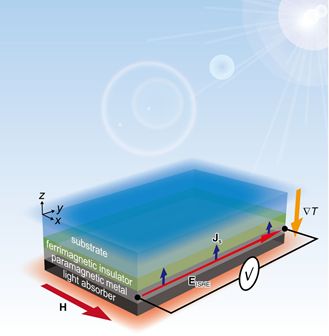
Thermal emission is radiated from the top of the device, keeping it cool, while sunlight is absorbed at the bottom, keeping that part warm. The temperature gradient and types of materials used lead to the generation of a spin current that is converted to thermoelectric voltage.


Scientists have known for at least 200 years that electricity can be generated from a temperature gradient, a phenomenon called thermoelectric generation. Recently, researchers have developed thermoelectric conversion technologies by changing material parameters and introducing new principles. For example, researchers have found that magnetic materials can generate thermoelectric voltage by inducing a flow of electron spins along a temperature gradient, called the spin Seebeck effect, and that increasing a device's length perpendicular to the gradient boosts voltage. Scientists would like to fabricate more efficient, thin thermoelectric devices based on the spin Seebeck effect. However, the thinner the device, the more difficult it is to maintain a temperature gradient between its top and bottom.

Satoshi Ishii and Ken-ichi Uchida of Japan's National Institute for Materials Science and colleagues have solved this problem by making a device with magnetic layers that continuously cools at the top and absorbs heat from the sun at the bottom. In this way, the device harvests two types of energy. Radiative cooling occurs at the top, as heat is lost from a material in the form of infrared radiation, while solar radiation is absorbed at the bottom.

"It is really important to take full advantage of renewable energy in order to achieve a more sustainable society," explains Ishii. "Daytime radiative cooling and solar heating have both been used to improve a variety of thermoelectric applications. Our device uses both types of energy simultaneously to generate a thermoelectric voltage."

Here's how it works:

The device has four layers. The top layer is a weak paramagnet made of gadolinium gallium garnet. This layer is transparent to sunlight and emits thermal radiation to the universe, getting cooler. Sunlight passes through to the following ferrimagnetic layer made of yttrium iron garnet. This layer is also transparent, so light continues to travel down into the bottom two light-absorbing layers, made of paramagnetic platinum and blackbody paint. The bottom section stays warm due to sunlight absorption. The spin current is generated in the ferromagnetic layer owing to the temperature gradient between the top and bottom of the device and is converted to electric voltage in the paramagnetic platinum layer.

The device works best on clear days, as clouds reduce the achievable temperature gradient by blocking the emitted infrared radiation from passing through the atmosphere and reducing the solar heating.

While promising, the device's thermoelectric generation efficiency was still quite low. The team plans to boost its efficiency by improving the design, experimenting with different material combinations, and developing even more novel strategies for thermoelectric generation.

Further information
Satoshi Ishii
National Institute for Materials Science
Email: sishii@nims.go.jp

Ken-ichi Uchida
National Institute for Materials Science
Email: UCHIDA.Kenichi@nims.go.jp

About Science and Technology of Advanced Materials Journal

Open access journal STAM publishes outstanding research articles across all aspects of materials science, including functional and structural materials, theoretical analyses, and properties of materials. Website: https://www.tandfonline.com/toc/tsta20/current

Dr. Yoshikazu Shinohara
STAM Publishing Director
Email: SHINOHARA.Yoshikazu@nims.go.jp

Press release distributed by ResearchSEA for Science and Technology of Advanced Materials.

Copyright 2021 ACN Newswire. All rights reserved. http://www.acnnewswire.com

Spinning electricity from heat and cold

TSUKUBA, Japan, Jun 29, 2021 – (ACN Newswire) – A new device harvests two types of energy during the daytime, making it cool on one end and hot on the other, to generate electricity around the clock. With further improvements, the device could be used in off-grid Internet-of-things sensors. The details were published in the journal Science and Technology of Advanced Materials.


Thermal emission is radiated from the top of the device, keeping it cool, while sunlight is absorbed at the bottom, keeping that part warm. The temperature gradient and types of materials used lead to the generation of a spin current that is converted to thermoelectric voltage.


Scientists have known for at least 200 years that electricity can be generated from a temperature gradient, a phenomenon called thermoelectric generation. Recently, researchers have developed thermoelectric conversion technologies by changing material parameters and introducing new principles. For example, researchers have found that magnetic materials can generate thermoelectric voltage by inducing a flow of electron spins along a temperature gradient, called the spin Seebeck effect, and that increasing a device's length perpendicular to the gradient boosts voltage. Scientists would like to fabricate more efficient, thin thermoelectric devices based on the spin Seebeck effect. However, the thinner the device, the more difficult it is to maintain a temperature gradient between its top and bottom.

Satoshi Ishii and Ken-ichi Uchida of Japan's National Institute for Materials Science and colleagues have solved this problem by making a device with magnetic layers that continuously cools at the top and absorbs heat from the sun at the bottom. In this way, the device harvests two types of energy. Radiative cooling occurs at the top, as heat is lost from a material in the form of infrared radiation, while solar radiation is absorbed at the bottom.

"It is really important to take full advantage of renewable energy in order to achieve a more sustainable society," explains Ishii. "Daytime radiative cooling and solar heating have both been used to improve a variety of thermoelectric applications. Our device uses both types of energy simultaneously to generate a thermoelectric voltage."

Here's how it works:

The device has four layers. The top layer is a weak paramagnet made of gadolinium gallium garnet. This layer is transparent to sunlight and emits thermal radiation to the universe, getting cooler. Sunlight passes through to the following ferrimagnetic layer made of yttrium iron garnet. This layer is also transparent, so light continues to travel down into the bottom two light-absorbing layers, made of paramagnetic platinum and blackbody paint. The bottom section stays warm due to sunlight absorption. The spin current is generated in the ferromagnetic layer owing to the temperature gradient between the top and bottom of the device and is converted to electric voltage in the paramagnetic platinum layer.

The device works best on clear days, as clouds reduce the achievable temperature gradient by blocking the emitted infrared radiation from passing through the atmosphere and reducing the solar heating.

While promising, the device's thermoelectric generation efficiency was still quite low. The team plans to boost its efficiency by improving the design, experimenting with different material combinations, and developing even more novel strategies for thermoelectric generation.

Further information
Satoshi Ishii
National Institute for Materials Science
Email: sishii@nims.go.jp

Ken-ichi Uchida
National Institute for Materials Science
Email: UCHIDA.Kenichi@nims.go.jp

About Science and Technology of Advanced Materials Journal

Open access journal STAM publishes outstanding research articles across all aspects of materials science, including functional and structural materials, theoretical analyses, and properties of materials. Website: https://www.tandfonline.com/toc/tsta20/current

Dr. Yoshikazu Shinohara
STAM Publishing Director
Email: SHINOHARA.Yoshikazu@nims.go.jp

Press release distributed by ResearchSEA for Science and Technology of Advanced Materials.

Copyright 2021 ACN Newswire. All rights reserved. http://www.acnnewswire.com

Better memristors for brain-like computing

TSUKUBA, Japan, May 15, 2021 – (ACN Newswire) – Scientists are getting better at making neurone-like junctions for computers that mimic the human brain's random information processing, storage and recall. Fei Zhuge of the Chinese Academy of Sciences and colleagues reviewed the latest developments in the design of these 'memristors' for the journal Science and Technology of Advanced Materials.


Researchers are developing computer hardware for artificial intelligence that allows for more random and simultaneous information transfer and storage, much like the human brain.


Computers apply artificial intelligence programs to recall previously learned information and make predictions. These programs are extremely energy- and time-intensive: typically, vast volumes of data must be transferred between separate memory and processing units. To solve this issue, researchers have been developing computer hardware that allows for more random and simultaneous information transfer and storage, much like the human brain.

Electronic circuits in these 'neuromorphic' computers include memristors that resemble the junctions between neurones called synapses. Energy flows through a material from one electrode to another, much like a neurone firing a signal across the synapse to the next neurone. Scientists are now finding ways to better tune this intermediate material so the information flow is more stable and reliable.

"Oxides are the most widely used materials in memristors," says Zhuge. "But oxide memristors have unsatisfactory stability and reliability. Oxide-based hybrid structures can effectively improve this."

Memristors are usually made of an oxide-based material sandwiched between two electrodes. Researchers are getting better results when they combine two or more layers of different oxide-based materials between the electrodes. When an electrical current flows through the network, it induces ions to drift within the layers. The ions' movements ultimately change the memristor's resistance, which is necessary to send or stop a signal through the junction.

Memristors can be tuned further by changing the compounds used for electrodes or by adjusting the intermediate oxide-based materials. Zhuge and his team are currently developing optoelectronic neuromorphic computers based on optically-controlled oxide memristors. Compared to electronic memristors, photonic ones are expected to have higher operation speeds and lower energy consumption. They could be used to construct next generation artificial visual systems with high computing efficiency.

Further information
Fei Zhuge
Chinese Academy of Sciences
Email: zhugefei@nimte.ac.cn

About Science and Technology of Advanced Materials Journal

Open access journal STAM publishes outstanding research articles across all aspects of materials science, including functional and structural materials, theoretical analyses, and properties of materials.

Dr. Yoshikazu Shinohara
STAM Publishing Director
Email: SHINOHARA.Yoshikazu@nims.go.jp

Press release distributed by ResearchSEA for Science and Technology of Advanced Materials.

Copyright 2021 ACN Newswire. All rights reserved. http://www.acnnewswire.com

Dye-based device sees the invisible

Tsukuba, Japan, Apr 16, 2021 – (ACN Newswire) – Scientists in Europe have designed an organic dye-based device that can see light waves in the shortwave infrared (SWIR) range. The device is easy to make using cheap materials, and is stable at high temperatures. The findings, published in the journal Science and Technology of Advanced Materials, could lead to more widespread use of inexpensive consumer SWIR imaging and sensing devices.


In the upconversion device, shortwave infrared (SWIR) light with wavelengths beyond 1,000 nm is absorbed by the squaraine dye in the photodetector (PD), producing electrical charges. Charges flow into the organic light-emitting diode (OLED), where they recombine under the emission of visible light. This way, SWIR light, which cannot be detected by the human eye, is converted into visible light.


The human eye can only detect a very narrow segment of the electromagnetic spectrum, from around 400 to 700 nanometers. The SWIR region, on the other hand, extends from 1,000 to 2,500 nanometers. Specially designed cameras can take images of objects that reflect waves in the SWIR region. They are used for improving night vision, in airborne remote sensing, and deep tissue imaging. The cameras also help assess the composition and quality of silicon wafers, building structures and even food produce.

"These cameras are typically difficult to manufacture and are quite expensive, as they are made of inorganic semiconductor photodiode arrays interconnected with read-out integrated circuitry," says Roland Hany of the Swiss Federal Laboratories for Materials Science and Technology.

Hany worked with colleagues in Switzerland and Italy to design an organic dye-based 'SWIR upconversion device' that efficiently converts shortwave infrared light to visible light.

The device uses organic (materials made with carbon) components: a squaraine dye-coated flexible substrate combined with a fluorescent organic light-emitting diode (OLED). When the dye absorbs SWIR waves, an electric current is generated and directly converted into a visible image by the OLED.

The team had to play with the molecular composition of several squaraine dyes to get them to absorb specific wavelengths. Ultimately, they synthesized squaraine dyes that absorb SWIR light beyond 1,200 nanometers and remained stable up to 200 degrees Celsius. The finished dye-based device performed stably for several weeks under normal laboratory conditions.

"All-organic upconverters could lead to applications that can't be realized with current technology. For example, invisible night vision devices can be directly integrated into car windscreens without affecting the visual field," explains Hany.

The team is now working on shifting the dye's absorption further into the SWIR range. They are also using machine learning techniques to find new dye molecules capable of sensing SWIR waves. Finally, the team aims to improve device stability and sensitivity.

Further information
Roland Hany
Empa, Swiss Federal Laboratories for Materials Science and Technology
Email: roland.hany@empa.ch

About Science and Technology of Advanced Materials Journal

Open access journal STAM publishes outstanding research articles across all aspects of materials science, including functional and structural materials, theoretical analyses, and properties of materials.

Dr. Yoshikazu Shinohara
STAM Publishing Director
Email: SHINOHARA.Yoshikazu@nims.go.jp

Press release distributed by ResearchSEA for Science and Technology of Advanced Materials.

Copyright 2021 ACN Newswire. All rights reserved. http://www.acnnewswire.com

TANAKA Memorial Foundation Announces Recipients of Precious Metals Research Grants

TOKYO, Mar 31, 2021 – (ACN Newswire) – The TANAKA Memorial Foundation's Representative Director, Hideya Okamoto, announced the recipients of the FY2020 Precious Metals Research Grants.

Following a rigorous screening process, the Gold Awards, each for 2 million yen, were presented to Professor Yasushi Sekine and Professor Hideyuki Murakami, both of Waseda University. In addition, three research projects received Silver Awards, and four Young Researcher Awards were presented.

The TANAKA Memorial Foundation undertakes programs designed to foster developments in new precious metal fields while contributing to the advancement of science, technology, and socio-economics for the overall enrichment of society. The research grant program was launched in FY1999 and has continued each year since with the goal of supporting the various challenges of the "new world opened up by precious metals." This year, the program's 22nd year, a total of 171 applications were received in a wide range of fields where precious metals can make contributions to the research and development of new technologies. A total of 16.1 million yen in research grants was awarded for 26 projects.

The names of the two Gold Award recipients, their research, and the reasons for their selection are below.

– Professor Yasushi Sekine, Waseda University
Development and application of precious metal catalytic reactions with unconventional low-temperature action using surface protonics
This research seeks to develop solid catalyst reactions at low temperatures (from room temperature to 200 degrees) using surface protonics. This research and development was highly rated for its potential contributions to the SDGs and ESG investment as well as its ability to make major contributions to the government's target of achieving carbon neutrality by 2050.

– Professor Hideyuki Murakami, Waseda University
Development of oxidation resistant Ir-based high-entropy alloy
This research seeks to develop high-entropy alloys, a new category of metal materials that are currently the focus of significant attention, using an iridium (Ir) based alloy to create a material with excellent high-temperature characteristics and oxidation resistance. This research was highly rated because it may lead to a solution to the problem of Ir depletion at high temperatures in the range of 1,000 degrees Celsius and may improve ductility, which is an issue for Ir alloys.

Three Silver Awards, four Young Researcher Awards, and 17 Encouragement Awards were also granted. The recipients and an overview of the Precious Metals Research Grants are indicated below. Applications for the FY2021 research granted are scheduled to open in the fall.

List of FY2020 Precious Metals Research Grants Recipients

– Platinum Award (0 award, 5 million yen)
Non granted

– Gold Award (2 awards, 2 million yen each)

Yasushi Sekine, Professor, Waseda University
Development and application of precious metal catalytic reactions with unconventional low-temperature action using surface protonics

Hideyuki Murakami, Professor, Waseda University
Development of oxidation resistant Ir-based high-entropy alloy

– Silver Awards (3 awards, 1 million yen each)

Ryuji Tamura, Professor, Tokyo University of Science
Precious metal hyper-materials

Masahito Inagaki, Researcher, Nagoya University
Development of nucleic acid cutting technology using silver nano-particles and pharmaceutical development applications

Tatsuya Oshima, Professor, University of Miyazaki
Search for and discovery of optimal ion solvation extraction agent for gold extraction and separation processes

– Young Researcher Awards (4 awards, 1 million yen each)

Noriyuki Uchida, Specially Appointed Assistant Professor, Tokyo University of Agriculture and Technology
Photonic precious metal crystal sensors made primarily from water

Yuki Ueda, Researcher, Tokyo Institute of Technology
Development of precious metal element separation and recovery processes using the hydrophobicity of fluorous solvents

Rajashekar Badam, Senior Lecturer, Japan Advanced Institute of Science and Technology
IrO2-based organic-inorganic hybrid catalyst with strong metal-base interaction with efficient oxygen generation catalytic activity suitable for water decomposition

Yohei Ishida, Assistant Professor, Hokkaido University
Self-synthesis of multi-element alloy clusters using nano-chemical reaction fields

– Encouragement Award (17 awards, 300,000 yen each)
Shunsuke Shiba, Assistant Professor, EHIME University
Takayuki Iseki, Specially Appointed Prof., Osaka University
Chen Chuantong, Associate Professor, Osaka University
Kohsuke Mori, Associate Professor, Osaka University
Hiromi Yuasa, Professor, Kyushu University
Yoshikazu Hirai, Assistant Professor, Kyoto University
Ken-ichi Fujita, Professor, Kyoto University
Ryo Kasuya, Senior Researcher, National Institute of Advanced Industrial Science and Technology
Masahiro Aoyama, Assistant Professor, Shizuoka University
Daisuke Nagai, Associate Professor, University of Shizuoka
Takanari Ouchi, Research Associate, The University of Tokyo
Takuto Soma, Assistant Professor, Tokyo Institute of Technology
Kohei Fujiwara, Associate Professor, Tohoku University
Atsushi Satsuma, Professor, Nagoya University
Naoki Ishimatsu, Assistant Professor, Hiroshima University
Takuya Yamamoto, Associate Professor, Hokkaido University
Yoshiaki Nishijima, Associate Professor, YOKOHAMA National University

Overview of the 2020 Precious Metals Research Grants

Conditions:
Research content that falls under any of the following
– New technology related to precious metals
– Research and development related to precious metals that bring about innovative evolution in products
– Research and development of new products using precious metals
*Precious metal refers to eight elements of platinum, gold, silver, palladium, rhodium, iridium, ruthenium and osmium.
*If development is conducted jointly (or planned to be) with other material manufacturers, please indicate so.
*Products that have already been commercialized, put to practical use, or that are planned are not eligible.

Grant Amounts:
– Platinum Award: 5 million yen (1 award)
– Gold Award: 2 million yen (1 award)
– Silver Awards: 1 million yen (4 awards)
– Young Researcher Awards: 1 million yen (2 awards)
– Encouragement Award: 300,000 yen (several awards)
*The grant amount is treated as a scholarship donation.
*Awards may not be granted in some cases.
*The number of awards is subject to change.

Eligible Candidates:
– Personnel who belong to (or work for) educational institutions in Japan (universities, graduate schools, or technical colleges) or public and related research institutions may participate.
*As long as the applicant is affiliated with a research institution in Japan, the base of activity can be in Japan or overseas.
*The Young Researcher Awards are for researchers under the age of 37 as of April 1, 2020.

Application Period:
– 9am, September 1, 2020 (Tue) – 5pm, November 30, 2020 (Mon)

Inquiries Concerning the Research Grant Program:
Precious Metals Research Grants Office
Marketing Department, TANAKA Kikinzoku Kogyo K.K.
22F Tokyo Building, 2-7-3 Marunouchi, Chiyoda-ku, Tokyo 100-6422
TEL: 03-6311-5596 FAX: 03-6311-5529 E-mail: joseikin@ml.tanaka.co.jp
TANAKA Memorial Foundation website: https://tanaka-foundation.or.jp

Press release in PDF: http://www.acnnewswire.com/pdf/files/20210331_EN.pdf

TANAKA Memorial Foundation
Established: April 1, 2015
Address: 22F Tokyo Building, 2-7-3 Marunouchi, Chiyoda-ku, Tokyo
Representative: Hideya Okamoto (Senior Advisor to TANAKA Holdings Co., Ltd.)
Purpose of Business: To provide grants for research related to precious metals to contribute to the development and cultivation of new fields for precious metals, and to the development of science, technology, and the social economy.
Areas of Business:
– Provision of grants for scientific and technological research related to precious metals.
– Recognition of excellent analysis of precious metals and holding of seminars and other events.

TANAKA Kikinzoku Kogyo K.K.
Headquarters: 22F, Tokyo Building, 2-7-3 Marunouchi, Chiyoda-ku, Tokyo
Representative: Koichiro Tanaka, Representative Director & CEO
Founded: 1885
Incorporated: 1918
Capital: 500 million yen
Employees: 2,393 (as of March 31, 2020)
Sales: JPY 992,679,879,000 (FY2019)
Main businesses: Manufacture, sales, import and export of precious metals (platinum, gold, silver, and others) and various types of industrial precious metals products.
URL: https://tanaka-preciousmetals.com

Press Inquiries
TANAKA Holdings Co., Ltd.
https://tanaka-preciousmetals.com/en/inquiries-for-media/

Copyright 2021 ACN Newswire. All rights reserved. http://www.acnnewswire.com

Putting a spin on Heusler alloys

Tsukuba, Japan, Mar 30, 2021 – (ACN Newswire) – A study published in the journal Science and Technology of Advanced Materials summarizes the major achievements made to-date in Heusler alloy research. "Our review article can serve as an ideal reference for researchers in magnetic materials," says Atsufumi Hirohata of the University of York, UK, who specializes in spintronics.


Spin 'batteries' use electron spins, instead of their charge, to power spintronic devices.


Spintronics, also known as spin electronics, is a field of applied physics that studies the use of electron spins, instead of their charge, to carry information in solid-state devices, with reduction in power consumption and improvements in memory and processing capabilities.

A category of materials showing great promise in this area is Heusler alloys: materials formed of one or two parts metal X, one part metal Y, and one part metal Z, each coming from a distinct part of the periodic table of elements. The interesting thing about these alloys is that individually, the metals are not magnetic, but when combined, they become magnetic.

A major advantage of Heusler alloys for spintronic devices is the ability to control their unique electrical and magnetic properties, which result directly from electron spins, by making changes to their crystalline structures. But this requires very high temperatures, which researchers want to reduce.

Over the last few decades, scientists have been working on approaches to grow Heusler alloy films at room temperature on special substrates with crystal lattices that are similar to the alloy's. The interaction between the two lattices can lead to the development of half-metallicity in the Heusler alloy, where only electrons spinning in one orientation are conducted through the material whereas those spinning in another are not.

Researchers need to be able to measure the properties of materials in order to conduct their investigations. The atomic structure of Heusler alloys can be directly observed by X-ray diffraction and indirectly measured through examining the relationship between the material's resistance to an electric current and temperature changes. Other techniques are also available for measuring their magnetic properties.

Hirohata and his colleagues are currently working on fabricating a metallic magnetic junction made of Heusler alloy films. These junctions are made from two ferromagnets separated by a thin insulator. When the insulating layer is thin enough, electrons are able to tunnel from one ferromagnet to the other. There is low resistance to electron movement as long as an external magnetic field is applied, but as soon as it is removed, the material becomes highly resistant to electron movement. "These devices are expected to replace currently used memory cells and magnetic sensors," says Hirohata. The team hopes to develop metallic magnetic junctions with much larger magnetoresistance than the current record at room temperature, realising a next-generation memory for a sustainable society.

Research paper: https://www.tandfonline.com/doi/full/10.1080/14686996.2020.1812364

Further information
Atsufumi Hirohata
University of York
Email: atsufumi.hirohata@york.ac.uk

About Science and Technology of Advanced Materials Journal

Open access journal STAM publishes outstanding research articles across all aspects of materials science, including functional and structural materials, theoretical analyses, and properties of materials.

Chikashi Nishimura
STAM Publishing Director
Email: NISHIMURA.Chikashi@nims.go.jp

Press release distributed by ResearchSEA for Science and Technology of Advanced Materials.

Copyright 2021 ACN Newswire. All rights reserved. http://www.acnnewswire.com

Size matters: Bimodal imaging receives nanoparticle enhancement

Tsukuba, Japan, Mar 10, 2021 – (ACN Newswire) – Scientists have found a way to control the size of special nanoparticles to optimize their use for both magnetic resonance and near-infrared imaging. Their approach could help surgeons use the same nanoparticles to visualize tumours just before and then during surgery using the two different imaging techniques. Their findings were published in the journal Science and Technology of Advanced Materials.


The scientists injected the nanoparticle solution into the tail veins of live mice and were able to obtain high quality MRI (L) and near-infrared fluorescence (R) scans of tissues and blood vessels.


"Magnetic resonance imaging is routinely used in pre-operative diagnosis, while surgeons have started using near-infrared fluorescence imaging during surgical procedures," says nanobiotechnologist Kyohei Okubo of Tokyo University of Science. "Our nanoparticle probes could provide a bimodality that will be clinically appealing to medical device researchers and doctors."

Ceramic nanoparticles made with the rare earth metals ytterbium (Yb) and erbium (Er) have demonstrated low toxicity and prolonged near-infrared luminescence, showing promise as a contrast agent in MRI scans and a fluorescing agent for near-infrared fluorescence imaging. Images of blood vessels and organs in live bodies can be obtained with the two imaging techniques by further modifying the nanoparticle surfaces with polyethylene glycol (PEG)-based polymers. But to improve image resolution, scientists need to have more control over nanoparticle size during the fabrication process.

Okubo and his colleagues used a step-by-step fabrication process that starts with mixing rare earth oxides in water and trifluoracetic acid. The mixture is heated to form a solid. Then it is dissolved in solution, oleic acid is added and gas is removed. So-called rare-earth-doped ceramic nanoparticles form when this solution is cooled.

A few more steps lead to the coating of the nanoparticle surfaces with PEG. The scientists found they could slow the growth rate of the nanoparticles by increasing their concentration before the coating process. This allowed them to form nanoparticles 15 and 45 nanometres in diameter.

The team conducted a series of tests to examine the properties of their nanoparticles. They found that they could be used for obtaining high-quality images of blood vessels in live mice using MRI and near-infrared fluorescence imaging techniques. Further tests showed the nanoparticles exhibited minimal toxicity on mouse fibroblast cells when used in low concentrations. They also have a short half-life, meaning they would be cleared relatively quickly from the body, making them safe for clinical use.

The team next aims to investigate how different distributions of paramagnetic ions on the nanoparticles affect their magnetic properties. They also aim to study whether modifications made to the nanoparticles could make them applicable for use in light-based 'photodynamic' therapies for treating skin cancers and acne, for example.

Further information
Kyohei Okubo
Tokyo University of Science
Email: kyohei.okubo@rs.tus.ac.jp

About Science and Technology of Advanced Materials Journal

Open access journal STAM publishes outstanding research articles across all aspects of materials science, including functional and structural materials, theoretical analyses, and properties of materials.

Chikashi Nishimura
STAM Publishing Director
Email: NISHIMURA.Chikashi@nims.go.jp

Press release distributed by ResearchSEA for Science and Technology of Advanced Materials.

Copyright 2021 ACN Newswire. All rights reserved. http://www.acnnewswire.com
Elastomers develop stronger bonds of attachment

Tsukuba, Japan, Feb 12, 2021 – (ACN Newswire) – Elastomers are the soft, elastic materials, like gels and rubbers, that are found in automobile and airplane parts, in sports equipment, and are used to protect precision machinery and buildings against vibrations. Scientists now want to make them thinner and tougher, without losing elasticity. Nagoya University materials engineer Yukikazu Takeoka and colleagues reviewed the most recent efforts towards improving elastomers for the journal Science and Technology of Advanced Materials.


Different kinds of bonds can link elastomer chains together, changing how the material behaves. (Credit: Yukikazu Takeoka)


"Our review gives hints about the kind of molecular thinking that needs to go into making elastomers tougher," says Takeoka.

Elastomers are made of many, long molecular chains of repeating subunits. They can undergo large deformations when stretched, returning to their original shape when the tension is released. They can do this because their molecular chains have enough mobility to stretch and crunch up.

Elasticity and overall toughness depends on the interactions between the molecular chains inside the material. Scientists have been working on controlling how chains link together and interact in order to change elastomers' mechanical properties.

Takeoka and his team from Nagoya University's department of molecular and macromolecular chemistry explain that elastomers can be made tougher by introducing strong hydrogen or ionic bonds that can reversibly link elastomer chains together. These reversible bonds attach and detach from the elastomer chains as the material deforms. Scientists have used hydrogen bonds to fabricate strong hydrogels that can deform up to 600% and return to their original state within three minutes at 37 degrees Celsius or a few seconds at 50 degrees Celsius.

Elastomer chains can also be linked through ring-like 'cyclic' molecules, giving linked chains a large degree of flexibility and improved toughness. A team of scientists fabricated a very flexible elastomer by mixing solutions of polyethylene glycol and cyclic alpha-cyclodextrin in water.

Takeoka and his colleagues suggest that further combining elastomers linked by reversible bonds and moving cyclic molecules could lead to even tougher elastomers with better elongation. "Our review emphasizes the importance of examining molecular behaviour in detail while designing polymer materials," says Takeoka.

Paper: https://www.tandfonline.com/doi/full/10.1080/14686996.2020.1849931

Further information
Yukikazu Takeoka
Nagoya University
Email: ytakeoka@chembio.nagoya-u.ac.jp

About Science and Technology of Advanced Materials Journal

Open access journal STAM publishes outstanding research articles across all aspects of materials science, including functional and structural materials, theoretical analyses, and properties of materials.

Chikashi Nishimura
STAM Publishing Director
NISHIMURA.Chikashi@nims.go.jp

Press release distributed by ResearchSEA for Science and Technology of Advanced Materials.

Copyright 2021 ACN Newswire. All rights reserved. http://www.acnnewswire.com
Materials coloured like a peacock

Tsukuba, Japan, Jan 26, 2021 – (ACN Newswire) – Melanin-like compounds can be precisely designed and arranged to colour materials using a mechanism similar to that found in a peacock's feathers. Chemist Michinari Kohri of Chiba University in Japan reviewed the latest research on these 'melanin-mimetic materials' and their potential applications for the journal Science and Technology of Advanced Materials.


Scientists are developing materials inspired by the structural colours in a peacock's feathers. (Credit: Takashi Tsujino)


Melanin and melanin-like compounds absorb some of the light that is scattered from the microstructures within materials. Scientists are finding ways to control this phenomenon to give a variety of iridescent and non-iridescent colours. (Credit: Michinari Kohri)


Melanin is a dark pigment that gives hair and skin its colour. It is also essential for the bright colours we see in some organisms. When light interacts with the structures of feathers, wings and shells of many organisms, like peacocks, butterflies and jewel beetles, it is scattered, appearing white. But when melanin is interspersed within these structures, some of the scattered light is absorbed, producing various colours. Scientists are looking for ways to mimic these so-called 'structural colour' changes of living organisms in synthetic materials.

"Vivid structural colours can be obtained by constructing microstructures containing a light-absorbing black material made of natural or artificial melanin," says Kohri. "Research in this area is progressing rapidly worldwide."

A leading contender is a compound called polydopamine. It is made of a material naturally found in the body, so it is biocompatible. It is also dark, so it absorbs light like melanin. Scientists found they could control polydopamine's iridescence – how much the colour changes as the angle of light hitting it shifts, similar to a peacock's feather. They achieved this by altering the particle size or by adding compounds that react to a magnetic field.

Scientists are also investigating particles formed of a polystyrene core and a polydopamine shell. Changing the diameter of the inner core, for example, leads to different colours. Making the polydopamine shell thicker causes the particles to be less closely packed, leading to non-iridescent structural colour, which remains the same regardless of the light angle.

Scientists have also toyed with controlling colour and angle-dependence by changing the shapes of polystyrene/polydopamine particles, making them hollow on the inside, and adding multiple coatings to the external shell.

Polydopamine particles are showing potential for a variety of applications. For example, they can be used as inks to dye fabrics or in cosmetics. They could help prove a product is real versus counterfeit by shifting colour with strong light, wetting, or temperature changes. Finally, scientists have found that adding these particles to rubber causes it to change colour when stretched or relaxed, which could be useful for sensing local stress and strain in bridges.

Further information
Michinari Kohri
Chiba University
Email: kohri@faculty.chiba-u.jp

About Science and Technology of Advanced Materials Journal

Open access journal STAM publishes outstanding research articles across all aspects of materials science, including functional and structural materials, theoretical analyses, and properties of materials.

Chikashi Nishimura
STAM Publishing Director
NISHIMURA.Chikashi@nims.go.jp

Press release distributed by ResearchSEA for Science and Technology of Advanced Materials.

Copyright 2021 ACN Newswire. All rights reserved. http://www.acnnewswire.com