Alaska Mining Sells 51% Interest to Australian Nanotechnology Specialist

KUALA LUMPUR, Aug 15, 2022 – (ACN Newswire) – Alaska Mining Sdn Bhd is pleased to announce that its sole shareholder, Lee Hon Kit, is selling a 51% interest in the Company amounting to A$5.0 million (RM15.2 million) under a share sale agreement to Nanopac Alaska Sdn Bhd (NASB).


Director of Nanopac Alaska Sdn Bhd Henry Cheang; Managing Director of Alaska Mining Sdn Bhd Lee Hon Kit; Acting CEO of Nanopac Alaska Sdn Bhd Tobby Tan, and Chairman of Nanopac Innovation Limited, Dato' Dr Cheng Kok Leong[L-R]


NASB is a unit of Nanopac Innovation Limited, which is listed on the Sydney-based National Stock Exchange of Australia. Nanopac principally engages in the research and development, manufacturing, distribution and servicing of nanotechnology materials and products. Nanopac's other businesses include Nano-Solar panels and raw materials for paint industry. Mr. Lee is the sole shareholder of Alaska Mining, which is an earthworks and mining specialist as well as a trader of a variety of goods and logistics services provider.

Under the agreement, the sale of the 51% interest in Alaska Mining by Mr. Lee to NASB will be satisfied through the issuance of new shares in Nanopac to be paid in two tranches. The first tranche of new shares amounting to A$2.5 million (RM7.77 million) will be paid up front following the share sale agreement while the second tranche of new shares amounting to A$2.5 million (RM7.77 million) will be paid out after the Company has achieved A$5.0 million (RM15.2 million) in net profit. As part of the share sale agreement, Mr. Lee will be appointed the managing director of Alaska Mining.

Alaska Mining has been granted rights to mine sands to be processed into silica and ilmenite, from which a Chinese business group has agreed to an offtake agreement in relation to part of the ilmenite produced.

Mr. Lee expressed that he is looking forward to working with NASB and Nanopac to grow the mining business and at the same time ensure there is a steady flow of silica for Nano-Solar panel production and ilmenite for its paint products.

"This acquisition is advantageous to Nanopac as this secures a steady flow of raw materials for Nano-Solar and existing line of products, which it would otherwise have to source through third parties."

"The mining operations will also give Nanopac a source of recurring income as the silica and ilmenite that it does not require will be sold to others while ensuring that the mining operations remain commercially sustainable, as the offtake agreement with the Chinese business group shows."

Mr. Tobby Tan, Acting Chief Executive Officer of NASB said, "We welcome Mr. Lee to the Nanopac family and we have no doubt that with his knowledge and experience, we will be able to grow the mining business to greater heights. We also believe that the acquisition of the stake will add to our production capabilities and is positive for the growth of Nanopac's solar panels and paints businesses."

Nanopac Alaska Sdn Bhd https://www.nanopac.com.my/

Copyright 2022 ACN Newswire. All rights reserved. http://www.acnnewswire.com

Singapore NASDAQ Listed Precision Cleaning Systems Manufacturer And A Provider of Centralized Dishwashing And Ancillary Services, JE Cleantech Holdings Rings Closing Bell

SINGAPORE, Aug 1, 2022 – (ACN Newswire) – JE Cleantech Holdings Limited (Nasdaq: JCSE), (the "Company"), Singapore's leading manufacturer of precision cleaning systems and a provider of centralized dishwashing and ancillary services, recently rang the closing bell of the NASDAQ stock exchange.


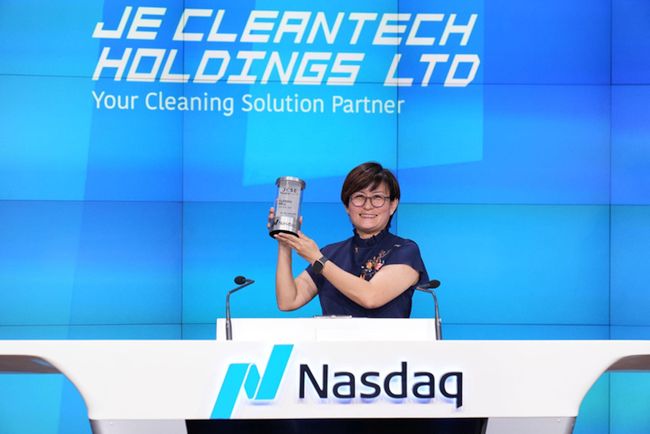
JE Cleantech Holdings Limited rings NASDAQ Closing Bell

Elise Hong, CEO and Co-Founder, JE Cleantech Holdings Limited

NASDAQ Tower, New York


JE Cleantech is a Singapore-based manufacturer of precision cleaning systems and a provider of centralized dishwashing and ancillary services in Singapore and Malaysia. Started in 1999, the company has an established local client network of long-term customers across Southeast Asia with a growing international footprint in markets such as Europe and the United States. The company also recently made its first foray into the tech hardware industry, securing its first contract to develop precision cleaning systems for a sensor products manufacturer.

About JE Cleantech Holdings Limited

JE Cleantech Holdings Limited is based in Singapore and is principally engaged in (i) the sale of cleaning systems and other equipment; and (ii) the provision of centralized dishwashing and ancillary services. Through its subsidiary, JCS-Echigo Pte Ltd, the company designs, develops, manufactures, and sells cleaning systems for various industrial end-use applications primarily to customers in Singapore and Malaysia. Its cleaning systems are mainly designed for precision cleaning, with features such as particle filtration, ultrasonic or megasonic rinses with a wide range of frequencies, high pressure drying technology, high flow rate spray, and deionized water rinses, which are designed for effective removal of contaminants and to minimize particle generation and entrapment. The Company also has provided centralized dishwashing services, through its subsidiary, Hygieia Warewashing Pte Ltd, since 2013 and general cleaning services since 2015, both mainly for food and beverage establishments in Singapore. http://www.jecleantech.sg/

For Media Enquiries and Investor Relations, please contact:
jcse@preciouscomms.com

Copyright 2022 ACN Newswire. All rights reserved. http://www.acnnewswire.com

JE Cleantech Secures More Than US$700,000 in New Orders During the First Half of 2022, Expands Capabilities into Tech Hardware

SINGAPORE, Jul 14, 2022 – (ACN Newswire) – JE Cleantech Holdings Limited (Nasdaq: JCSE), (the "Company"), a Cayman Islands company whose group operations are based in Singapore, today announced the receipt of a new order by its subsidiary, JCS-Echigo Pte Ltd, from a major customer in Singapore. Under this new order, the group will design, develop and manufacture a new precision cleaning system under the customer's specified requirements. The new order is valued at approximately US$700,000 and represents an expansion of JE Cleantech Holding's presence in the tech hardware industry.

The new customer designs and manufactures sensor products. The new customer is part of the international group that serves clients worldwide. With the new precision cleaning system by JCSE, the new customer will be able to deliver better services to its customers.

JE Cleantech Holdings has experience in manufacturing precision cleaning systems for a wide range of sectors – past orders include cleaning and equipment manufacturing for hard disk drives, semiconductors, biomedical, food and beverage, and industrial electronics companies. As a leading homegrown industrial manufacturer with a long and proven track record, the entry into this new sector demonstrates JE Cleantech's ability to apply its expertise to different sectors to scale and support its growth.

The precision-cleaning equipment manufacturing market in Singapore is estimated to reach an estimated S$143.0 million by 2025, marking a CAGR of 9.0 percent over the forecasted period. It also reflects an optimistic market outlook for the precision cleaning industry. The group also provides cleaning equipment and centralized washing services for food courts, hawker centers, restaurants, cookhouses, eldercare homes, and an inflight catering service provider. The Company has also maintained a healthy balance sheet through the height of the pandemic, the new partnership is the first step in a strong recovery for Singapore's industrial sector and positive prospects for the years to come.

In the near term, JE Cleantech intends to double production capacity. The Company is looking to further expand its product portfolio and increase the size of its R&D and engineering team. Longer-term, the Company aims to become the preferred choice for all industrial precision cleaning needs in Singapore.

About JE Cleantech Holdings Limited

JE Cleantech Holdings Limited is based in Singapore and is principally engaged in (i) the sale of cleaning systems and other equipment; and (ii) the provision of centralized dishwashing and ancillary services. Through its subsidiary, JCS-Echigo Pte Ltd, the company designs, develops, manufactures, and sells cleaning systems for various industrial end-use applications primarily to customers in Singapore and Malaysia. Its cleaning systems are mainly designed for precision cleaning, with features such as particle filtration, ultrasonic or megasonic rinses with a wide range of frequencies, high pressure drying technology, high flow rate spray, and deionized water rinses, which are designed for effective removal of contaminants and to minimize particle generation and entrapment. The Company also has provided centralized dishwashing services, through its subsidiary, Hygieia Warewashing Pte Ltd, since 2013 and general cleaning services since 2015, both mainly for food and beverage establishments in Singapore. http://www.jecleantech.sg/

For Media Enquiries and Investor Relations, please contact:
jcse@preciouscomms.com

Copyright 2022 ACN Newswire. All rights reserved. http://www.acnnewswire.com

JE Cleantech Secures More Than US$700,000 in New Orders During the First Half of 2022, Expands Capabilities into Tech Hardware

SINGAPORE, Jul 14, 2022 – (ACN Newswire) – JE Cleantech Holdings Limited (Nasdaq: JCSE), (the "Company"), a Cayman Islands company whose group operations are based in Singapore, today announced the receipt of a new order by its subsidiary, JCS-Echigo Pte Ltd, from a major customer in Singapore. Under this new order, the group will design, develop and manufacture a new precision cleaning system under the customer's specified requirements. The new order is valued at approximately US$700,000 and represents an expansion of JE Cleantech Holding's presence in the tech hardware industry.

The new customer designs and manufactures sensor products. The new customer is part of the international group that serves clients worldwide. With the new precision cleaning system by JCSE, the new customer will be able to deliver better services to its customers.

JE Cleantech Holdings has experience in manufacturing precision cleaning systems for a wide range of sectors – past orders include cleaning and equipment manufacturing for hard disk drives, semiconductors, biomedical, food and beverage, and industrial electronics companies. As a leading homegrown industrial manufacturer with a long and proven track record, the entry into this new sector demonstrates JE Cleantech's ability to apply its expertise to different sectors to scale and support its growth.

The precision-cleaning equipment manufacturing market in Singapore is estimated to reach an estimated S$143.0 million by 2025, marking a CAGR of 9.0 percent over the forecasted period. It also reflects an optimistic market outlook for the precision cleaning industry. The group also provides cleaning equipment and centralized washing services for food courts, hawker centers, restaurants, cookhouses, eldercare homes, and an inflight catering service provider. The Company has also maintained a healthy balance sheet through the height of the pandemic, the new partnership is the first step in a strong recovery for Singapore's industrial sector and positive prospects for the years to come.

In the near term, JE Cleantech intends to double production capacity. The Company is looking to further expand its product portfolio and increase the size of its R&D and engineering team. Longer-term, the Company aims to become the preferred choice for all industrial precision cleaning needs in Singapore.

About JE Cleantech Holdings Limited

JE Cleantech Holdings Limited is based in Singapore and is principally engaged in (i) the sale of cleaning systems and other equipment; and (ii) the provision of centralized dishwashing and ancillary services. Through its subsidiary, JCS-Echigo Pte Ltd, the company designs, develops, manufactures, and sells cleaning systems for various industrial end-use applications primarily to customers in Singapore and Malaysia. Its cleaning systems are mainly designed for precision cleaning, with features such as particle filtration, ultrasonic or megasonic rinses with a wide range of frequencies, high pressure drying technology, high flow rate spray, and deionized water rinses, which are designed for effective removal of contaminants and to minimize particle generation and entrapment. The Company also has provided centralized dishwashing services, through its subsidiary, Hygieia Warewashing Pte Ltd, since 2013 and general cleaning services since 2015, both mainly for food and beverage establishments in Singapore. http://www.jecleantech.sg/

For Media Enquiries and Investor Relations, please contact:
jcse@preciouscomms.com

Copyright 2022 ACN Newswire. All rights reserved. http://www.acnnewswire.com

ULVAC-PHI Launches Sales of Latest XPS System that Dramatically Accelerates Battery Research and Development

Chigasaki, Japan, Jul 5, 2022 – (ACN Newswire) – ULVAC-PHI Incorporated has launched the PHI GENESIS, an automated and multi-function scanning X-ray photoelectron spectrometer (XPS: X-ray Photoelectron Spectroscopy or ESCA: Electron Spectroscopy for Chemical Analysis). The PHI GENESIS is the united model of PHI's multi-functional scanning XPS instruments and was designed for automation and simplified operation.


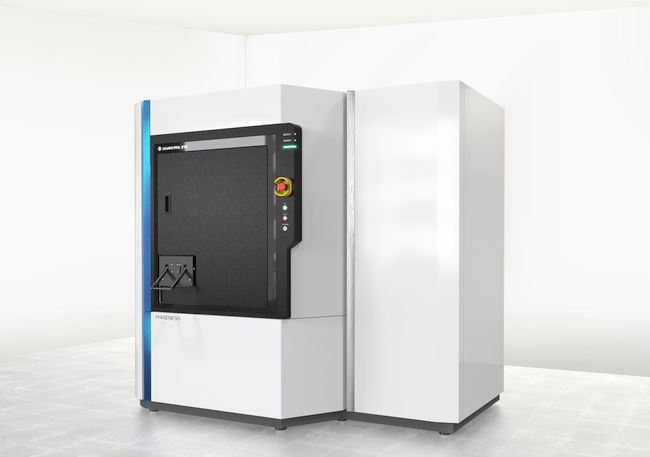
PHI GENESIS scanning X-ray photoelectron spectrometer


Background

Advanced materials such as all-solid-state batteries, advanced semiconductors, and artificial photosynthesis are complex combinations of materials, and their research and development require speed in optimizing the performance of each material as well as the combination of materials. There is a growing need for high-performance and highly functional surface and interface analysis that can dramatically accelerate such research and development. ULVAC-PHI begins offering a new surface analysis system that not only offers extremely high basic performance but also a high degree of automation to meet the various individual requirements of worldwide customers. The solution is the new "PHI GENESIS" scanning X-ray photoelectron spectrometer (XPS) from ULVAC-PHI.

Summary

The "PHI GENESIS" XPS is a new product that combines the core "GENESIS" of the PHI surface analysis instruments, which has a 50-year tradition of advanced automation and reduced analysis time, with expandability, and offers overwhelming basic performance in a compact housing.

The "PHI GENESIS" XPS provides high-speed, high-sensitivity, and overwhelming micro XPS analysis performance with automated multi-sample analysis with automatic sample exchange. A high-sensitivity analyzer with an improved counting rate also contributes to high performance. To date, ULVAC-PHI and Physical Electronics USA, a subsidiary of ULVAC-PHI, have developed various world-first XPS analysis technologies including scanning micro XPS and HAXPES (hard x-ray photoelectron spectroscopy), fully automated robotics XPS analysis, full-automatic insulator neutralization analysis, depth profiling of organic materials using cluster etching ion gun. All of these technologies are incorporated into a single instrument, making it possible to provide state-of-the-art XPS analysis technology for all kinds of materials, including metals, semiconductors, ceramics, and organic materials.

Another novel feature of PHI GENESIS is a new software package designed for ease of use and designed for all levels of users, from surface analysis beginners to well-trained scientists, from manufacturing to cutting-edge research and development. We have also prepared several options that allow customers to perform advanced analyses that previously required sophisticated analytical equipment such as a large synchrotron in a typical laboratory environment.

PHI GENESIS is fully compatible with the analysis of today's most advanced composite solid materials and composite solid devices and aims to dominate the global market as an indispensable analytical instrument for speeding up research and development.

About ULVAC-PHI, Incorporated

ULVAC-PHI, Incorporated was founded in 1982 and provides advanced surface analysis instruments to universities and leading-edge industries worldwide for research and development. The company provides comprehensive surface analysis technology-based solutions for materials and devices including metals, polymers, semiconductors, batteries, organic and inorganic devices and microelectronics. For more information, visit https://www.ulvac-phi.com/en/.

X-ray photoelectron spectroscopy (XPS)

XPS (X-ray Photoelectron Spectroscopy) is one of the most popular surface chemical analysis techniques that can provide chemical information on the top few atomic layers of a solid surface. XPS can provide qualitative and quantitative chemical information on solid surfaces by evaluating the energy and intensity of X-ray-induced electrons (photoelectrons). XPS is provided to universities and industrial research facilities as well as for quality control and quality assurance purposes, as it shows excellent features for the analysis of surface and interface phenomena such as coloration, adhesion, sliding, catalyst, thin-film interfaces and electrical contacts.

For inquiries regarding this matter, please contact
Product Strategy Department, ULVAC-PHI Corporation
TEL: +81-467-85-4220 (Sales)

Related website
https://www.ulvac-phi.com
https://www.surf-analysis.com

Copyright 2022 ACN Newswire. All rights reserved. http://www.acnnewswire.com

Novel patching material for bone defects

TSUKUBA, Japan, Jun 27, 2022 – (ACN Newswire) – Ceramics and metals have been used for a while as structural materials to repair bones and joints. In the past, scientists engineered bioinert materials, which do not bond to bones directly; bioactive materials that can bond to bones; and bio-absorbable materials that are categorized in bioactive materials but they are absorbed by the body over time and are replaced by advancing bone tissue.


A new bio-responsive ceramic can be used to repair bone defects

With an enzyme found in blood, different types of salts were converted to hydroxyapatite, a bone mineral


Now, a fourth type of bone repairing materials has been found: a bio-responsive ceramic that interacts with an enzyme found in blood to be absorbed into the body at a precise and predictable rate.

The research was done by Taishi Yokoi, an associate professor at the Institute of Biomaterials and Bioengineering at Tokyo Medical and Dental University, and his colleagues. The study was published in May in Science and Technology of Advanced Materials.

"Extending healthy life expectancy is an important issue for all of us," Yokoi says. "Bone repairing materials aid in the recovery of bone defects and help improve quality of life."

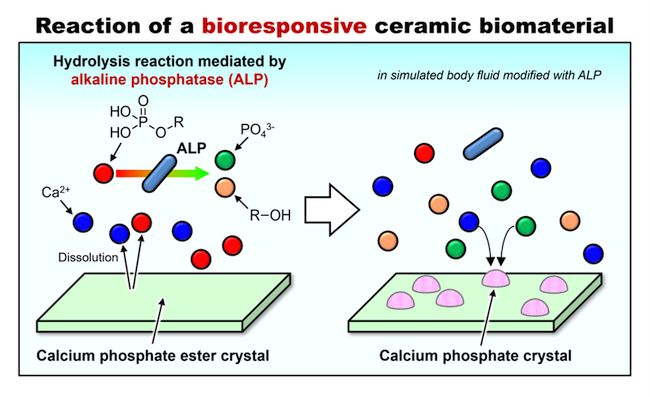
At the heart of this discovery is a biological reaction: an enzyme called alkaline phosphatase (ALP), which is present in human serum and reacts with various phosphate esters to generate bone mineral known as hydroxyapatite.

The scientists mimicked this process using a simulated body fluid that contained the enzyme ALP. They placed four different salts in a simulated body fluid containing or lacking the enzyme ALP. The salts were calcium salts of methyl phosphate (CaMeP), ethyl phosphate (CaEtP), butyl phosphate (CaBuP) and dodecyl phosphate (CaDoP). The phosphate component of each of these salts has an alkyl group at its end – a chain composed of hydrogen and carbon atoms – of differing lengths.

The scientists found that the first three salts were converted to hydroxyapatite, but only in the presence of ALP. Interestingly, the length of the alkyl group on the phosphate ester determined the rate at which this reaction happens. With more research, the scientists think that this could allow greater control of the bone healing process in the body.

"We expect the findings of this study will be applied towards designing and developing novel bone-repairing materials with precisely controlled degradation and resorption rates inside the body," says Yokoi.

Further information
Taishi Yokoi
Tokyo Medical and Dental University
Email: yokoi.taishi.bcr@tmd.ac.jp

Research paper: https://www.tandfonline.com/doi/full/10.1080/14686996.2022.2074801

About Science and Technology of Advanced Materials (STAM)

Open access journal STAM publishes outstanding research articles across all aspects of materials science, including functional and structural materials, theoretical analyses, and properties of materials. https://www.tandfonline.com/STAM

Mikiko Tanifuji
STAM Publishing Director
Email: TANIFUJI.Mikiko@nims.go.jp

Press release distributed by Asia Research News for Science and Technology of Advanced Materials.

Copyright 2022 ACN Newswire. All rights reserved. http://www.acnnewswire.com

TANAKA Establishes New Ruthenium Film Deposition Process that Contributes toward Miniaturization and Improved Durability of Semiconductors

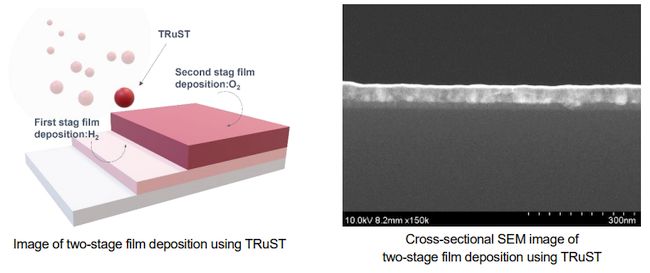
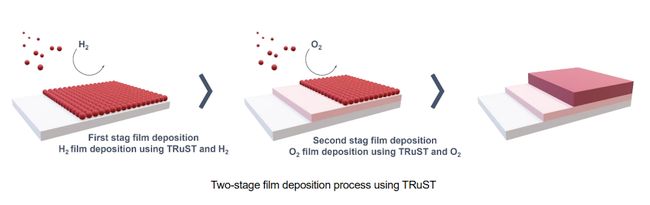
TOKYO, Jun 23, 2022 – (ACN Newswire) – TANAKA Kikinzoku Kogyo K.K. (Head office: Chiyoda-ku, Tokyo; Representative Director & CEO: Koichiro Tanaka), which operates the TANAKA Precious Metals manufacturing business, announced today that TANAKA has established a two-stage film deposition process using the liquid ruthenium (Ru) precursor "TRuST." TRuST is a precursor that has excellent reactivity with both oxygen and hydrogen and can form high-quality ruthenium films. This process is a two-stage atomic layer deposition (ALD) process that uses hydrogen film formation to create a thin anti-oxidation film and oxygen for the deposition of a high-quality ruthenium film. It eradicates concerns that the substrate will become oxidized and, at the same time, can prevent the drop in ruthenium purity that occurs during hydrogen film deposition.


The film deposition process was proposed by Professor Soo-Hyun Kim from the School of Materials Science and Engineering, College of Engineering, Yeungnam University in South Korea. The development and evaluation of the film deposition process were jointly conducted by Professor Kim and TANAKA Kikinzoku Kogyo.

This technology is expected to achieve greater miniaturization and improved durability of semiconductors. It can therefore be expected to be used in data centers and smartphones – which require even greater data processing capabilities – and contribute toward advanced technologies such as IoT and autonomous driving, which require sophisticated technological innovations.

Two-Stage Film Deposition Process Using Oxygen And Hydrogen

TANAKA Kikinzoku Kogyo is developing high-purity precious metal precursors?centered on ruthenium?for next-generation semiconductors. So far, single-stage film deposition using oxygen has been the mainstream process for film deposition. However, the company has now succeeded in a two-stage film deposition process using oxygen and hydrogen.

This two-stage film deposition process reduces the risk of surface oxidation of the base caused by hydrogen film deposition and allows high-purity film deposition that maintains ruthenium purity at almost 100% using oxygen film deposition. Furthermore, by forming the base first using hydrogen film deposition, the ruthenium film on top of the base created using oxygen film deposition will be smooth and dense, achieving a lower resistance than before.

Generally, specific resistivity increases when film thickness decreases, which is an issue in film deposition of semiconductors. With this new process, it was confirmed that an even lower resistance results from a two-stage film deposition that uses hydrogen in addition to oxygen film deposition, especially in the range of 10 nm and below. As semiconductors become even smaller in scale in the future, demand for thinner film deposition with low resistance is also expected for ruthenium films, and a two-stage film deposition allows this issue to be resolved. In addition, the new low-resistance, high-purity ruthenium film created by the two-stage film deposition can be achieved using the same raw materials and film deposition temperature for both stages. Therefore, film deposition is possible using the same film deposition equipment, allowing capital investment costs to be suppressed. Details will be announced at the AA2-TuA: ALD for BEOL session of the ALD 2022 conference being held in Ghent, Belgium, on June 28, 2022.

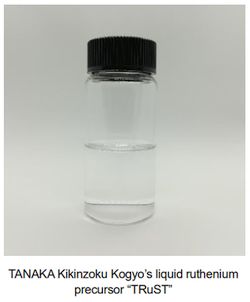
TANAKA Kikinzoku Kogyo's Liquid Ruthenium Precursor "TRuST"

In the past, the most common thin film and wiring materials used for semiconductors were copper, tungsten, and cobalt, but there are increasing expectations for the precious metal ruthenium to promote greater miniaturization of semiconductors because of its lower resistance and higher durability. Therefore, TANAKA Kikinzoku Kogyo developed TRuST – a liquid ruthenium precursor for chemical vapor deposition (CVD) and ALD that achieved the world's highest vapor pressure value – and started providing samples in 2020.

By increasing to the world's highest vapor pressure value, which is more than 100 times higher than existing precursors, this precursor raises the concentration of precursor in the film deposition chamber and the adsorption density of precursor molecules on the substrate surface, achieving excellent step coverage and improved film deposition speed.

State of the Semiconductor Industry and Background

The progress of advanced technologies such as IoT, AI, 5G, and the metaverse has led to rapidly increasing volumes of digital data used by digital devices such as smartphones. Therefore, in the development of semiconductors, the need for even greater miniaturization is increasing to enable the creation of devices with higher performance and lower energy consumption. In the aspect of durability, degradation due to base oxidation is also a major issue in semiconductor development. Furthermore, the development of electric vehicles and self-driving cars requires similar needs for the miniaturization of automotive semiconductors along with further improvement in durability.

In the semiconductor industry, which will require greater miniaturization and improved durability in the future, TANAKA Kikinzoku Kogyo seeks to further reduce costs and achieve higher quality by improving the film deposition speed of liquid ruthenium precursors. At the same time, the company will contribute to greater miniaturization and improved durability of semiconductors to support the development of new advanced technologies enabled by semiconductors.

Press release in PDF: https://www.acnnewswire.com/docs/files/202206_EN.pdf

About TANAKA Precious Metals

Since its foundation in 1885, TANAKA Precious Metals has built a portfolio of products to support a diversified range of business uses focused on precious metals. TANAKA is a leader in Japan regarding the volumes of precious metals handled. Over the course of many years, TANAKA has not only manufactured and sold precious metal products for industry but also provided precious metals in such forms as jewelry and assets. As precious metals specialists, all Group companies in Japan and around the world collaborate and cooperate on manufacturing, sales, and technology development to offer a range of products and services. With 5,193 employees, the group's consolidated net sales for the fiscal year ending March 31, 2021, was 1,425.6 billion yen.

Global industrial business website
https://tanaka-preciousmetals.com

Product inquiries
TANAKA Kikinzoku Kogyo K.K.
https://tanaka-preciousmetals.com/en/inquiries-on-industrial-products/

Press inquiries
TANAKA Holdings Co., Ltd.
https://tanaka-preciousmetals.com/en/inquiries-for-media/

Copyright 2022 ACN Newswire. All rights reserved. http://www.acnnewswire.com

TANAKA Launches “RE Series” Using 100% Recycled Precious Metals

TOKYO, Jun 8, 2022 – (ACN Newswire) – TANAKA Kikinzoku Kogyo K.K. (Head office: Chiyoda-ku, Tokyo; Representative Director & CEO: Koichiro Tanaka), which operates the TANAKA Precious Metals manufacturing business, announced today the launch of its RE Series of recycled precious metals, which uses 100% recycled materials as the source of gold, platinum, and other precious metals.
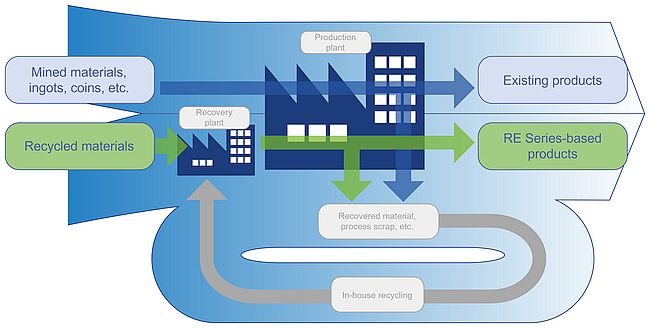

RE Series industrial-use product flow

RE Series logo


The RE Series is composed of materials refined from recycled precious metals only rather than from sources such as mined bullion. TANAKA Kikinzoku Kogyo has been operating a recycled precious metals business since it was established. It has now expanded its RE Series production line to manufacture products that use 100% recycled precious metal materials. In the future, the company will begin manufacturing and supplying products that use RE Series materials. In April 2022, TANAKA began using RE Series gold to supply PGC-RE, a gold compound for plating, as its first product using RE Series materials.

Through its RE Series, TANAKA Kikinzoku Kogyo hopes to continue contributing to the creation of the Sound Material-Cycle Society and to the reduction of carbon dioxide (CO2) emissions, both of which are needed worldwide. To help address social issues through the expansion of RE Series materials, the total volume of recycled materials needs to be increased. To achieve this, the company is calling on its customers for support as it increases the volume of recycled materials that it can accept to incorporate even more precious metals into the resource-recycling loop. At the same time, it will continue to drive research and development in its precious metals recycling business.

Over recent years, there has been a strong global push for companies to respond to issues such as the creation of the Sound Material-Cycle Society, carbon neutrality, SDGs, and ESG management. Within the precious metals market, customer needs and the responsibility of a company working with industrial businesses are creating an urgent need to offer sustainable materials and products.

The business of mining gold, platinum, and other precious metals requires vast amounts of energy. Also, because precious metals themselves are rare natural resources with limited reserves, expansion of the RE Series will improve the efficiency of use by reducing requirements for newly mined materials. Reductions in CO2 will also lead to reduced environmental impacts, which helps to create a more sustainable society.

Precious metal recycling is a key business at TANAKA Kikinzoku Kogyo. To contribute to global trends, the company is expanding its production line for RE Series materials, which are 100% recycled precious metals.

TANAKA Kikinzoku Kogyo and Precious Metal Recycling

Ever since it was established in 1885, TANAKA Kikinzoku Kogyo has operated a precious metal recycling business as one of its core businesses, with a comprehensive system of management within the Group from product recovery to refining and remanufacturing into new products. This total solution, a one-stop service for recycling, processing, and manufacturing, is an end-to-end process from material procurement through to processing, manufacturing, sales, and recycling without using on-market trading. This enables reduced lead times for customers and reduced costs of material procurement.

An important element of precious metal recycling is the ability to analyze the quantities of precious metals present in recycled materials, including those from automotive catalysts, industrial production scrap, and plant output. With advanced precious metal analysis technologies*1 developed through many years of research and development of precious metals, TANAKA Kikinzoku Kogyo is able to accurately evaluate materials recovered from customers.

Status of Precious Metal Recycling in Japan and Globally

Gold, platinum, and other precious metals are natural resources with low production volumes and limited reserves. Due to the uneven distribution of resources globally and the environmental destruction that mining causes, the availability of precious metals is expected to become even tighter in the future. Accordingly, research and development of precious metal recycling have continued around the world and have become more sophisticated over recent years.

In Japan, with the 1998 enactment of such things as the Home Appliance Recycling Law, legislation is being put in place, and technologies are being developed in the area of metal recycling. While the recycling of precious metals like gold and platinum is comparatively advanced, the recycling rates of gold and platinum group metals are around 30%, so there is still a lot of room for improvement.

In the European Union, where recycling is an important part of their economic activities, they have decided that recycling activities have been insufficient to date. Within the EU, they adopted the Circular Economy Package in 2015 with the aim of changing into a circular economy that uses circulative resources. China has also been focusing on recycling policies recently as it rapidly changes its industrial model through legislation.*2

About TANAKA Precious Metals

Since its foundation in 1885, TANAKA Precious Metals has built a portfolio of products to support a diversified range of business uses focused on precious metals. TANAKA is a leader in Japan regarding the volumes of precious metals handled. Over the course of many years, TANAKA has not only manufactured and sold precious metal products for industry but also provided precious metals in such forms as jewelry and assets. As precious metals specialists, all Group companies in Japan and around the world collaborate and cooperate on manufacturing, sales, and technology development to offer a range of products and services. With 5,193 employees, the Group's consolidated net sales for the fiscal year ending March 31, 2021, was 1,425.6 billion yen.

Global industrial business website
https://tanaka-preciousmetals.com/

Product inquiries
TANAKA Kikinzoku Kogyo K.K.
https://tanaka-preciousmetals.com/en/inquiries-on-industrial-products/

Press inquiries
TANAKA Holdings Co., Ltd.
https://tanaka-preciousmetals.com/en/inquiries-for-media/

*1 One measure of precious metal analysis capabilities is the status of Good Delivery Referee, an accreditation of the LBMA and LPPM, the most prestigious organizations in the field globally, which TANAKA Kikinzoku Group received as one of only five companies globally and the only company in Japan and the rest of Asia. The Group is also the first in Japan to acquire ISO/IEC 17025 accreditation for its analysis technologies for platinum, gold, silver, and palladium.

*2 Reference: TSC Foresight Vol.13, "Formulating Technical Strategies in the Area of Metal Recycling," December 2016, Technology Strategy Center (TSC), New Energy and Industrial Technology Development Organization (NEDO)

Copyright 2022 ACN Newswire. All rights reserved. http://www.acnnewswire.com

Machine learning speeds up search for new sustainable materials

TSUKUBA, Japan, May 25, 2022 – (ACN Newswire) – Researchers from Konica Minolta and the Nara Institute of Science and Technology in Japan have developed a machine learning method to identify sustainable alternatives for composite materials. Their findings were published in the journal Science and Technology of Advanced Materials: Methods.


Researchers are looking for sustainable options, such as recyclable materials or biomass, to substitute the constituent materials in composites which are used in various applications including electrical and information technologies.


Composite materials are compounds made of two or more constituent materials. Due to the complex nature of the interactions between the different components, their performance can greatly exceed that of single materials. Composite materials, such as fibre-reinforced plastics, are very important for a wide range of industries and applications, including electrical and information technologies.

In recent years, there has been increasing demand for more environmentally sustainable materials that help reduce industrial waste and plastic use. One way to achieve this is to substitute the constituent materials in composites with recyclable materials or biomass. However, this can reduce performance compared to the original material, not only due to the features of the individual constituent materials, such as their physicochemical properties, but also due to the interactions between the constituents.

"Finding a new composite material that achieves the same performance as the original using human experience and intuition alone takes a very long time because you have to evaluate countless materials while also taking into account the interactions between them," explains Michihiro Okuyama, assistant manager at Konica Minolta, Inc.

Machine learning offers a potential solution to this problem. Scientists have proposed several machine learning methods to conduct rapid searches among a large number of materials, based on the relationship between the materials' features and performance. However, in many cases the properties of the constituent materials are unknown, making these types of predictive searches difficult.

To overcome this limitation, the researchers developed a new type of machine learning method for finding alternative materials. A key advantage of the new method is that it can quantitatively evaluate the interactions among the component materials to reveal how much they contribute to the overall performance of the composite. The method then searches for replacement constituents with similar performance to the original material.

The researchers tested their method by searching for alternative constituent materials for a composite consisting of three materials – resin, a filler and an additive. They experimentally evaluated the performance of the substitute materials identified by machine learning and found that they were similar to the original material, proving that the model works.

"In developing alternatives, that make up composite materials, our new machine learning method removes the need to test large numbers of candidates by trial and error, saving both time and money." says Okuyama.

The method could be used to quickly and efficiently identify sustainable substitutes for composite materials, reducing plastic use and encouraging the use of biomass or renewable materials.

Further information
Michihiro Okuyama
KONICA MINOLTA, INC.
Email: michihiro.okuyama@konicaminolta.com

About Science and Technology of Advanced Materials: Methods (STAM Methods)

STAM Methods is an open access sister journal of Science and Technology of Advanced Materials (STAM), and focuses on emergent methods and tools for improving and/or accelerating materials developments, such as methodology, apparatus, instrumentation, modeling, high-through put data collection, materials/process informatics, databases, and programming. https://www.tandfonline.com/STAM-M

Dr. Masanobu Naito
STAM Methods Publishing Director
Email: NAITO.Masanobu@nims.go.jp

Press release distributed by Asia Research News for Science and Technology of Advanced Materials.

Copyright 2022 ACN Newswire. All rights reserved. http://www.acnnewswire.com

A new age of 2.5D materials

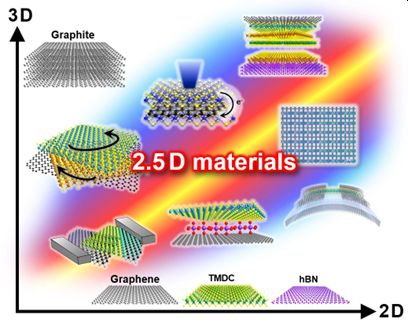
TSUKUBA, Japan, May 6, 2022 – (ACN Newswire) – Scientists are exploring new ways to artificially stack two-dimensional (2D) materials, introducing so-called 2.5D materials with unique physical properties. Researchers in Japan reviewed the latest advances and applications of 2.5D materials in the journal Science and Technology of Advanced Materials.


By stacking layers of different 2D materials, it is now possible to create 2.5D materials with unique physical properties that can be used in solar cells, quantum devices and devices with very low energy consumption. (Credit: STAM)


"The 0.5D concept symbolizes freedom from the composition, materials, angles and space typically used in 2D materials research," explains nanomaterials scientist and lead author Hiroki Ago of Kyushu University in Japan.

2D materials, like graphene, consist of a single layer of atoms and are used in applications like flexible touch panels, integrated circuits and sensors.

Recently, new methods have been introduced to make it possible to artificially stack 2D materials vertically, in-plane or at twisted angles regardless of their compositions and structures. This is thanks to the ability to control the van der Waals forces: weak electric interactions between atoms and molecules, similar to a microfiber cloth's attraction of dust. It is also now possible to integrate 2D materials with other dimensional materials, such as ions, nanotubes and bulk crystals.

A common method for fabricating 2.5D materials is chemical vapour deposition (CVD), which deposits a layer, one atom or molecule at a time, onto a solid surface. Commonly used building blocks for 2.5D materials include graphene, hexagonal boron nitride (hBN) (a compound used in cosmetics and aeronautics), and transition metal dichalcogenides (TMDCs) (a nanosheet semiconductor).

Using the CVD method, researchers selectively synthesized a bilayer of graphene, the simplest form of a 2.5D material, using a copper-nickel foil with relatively high nickel concentration as a catalyst. Nickel makes carbon highly soluble, giving researchers more control over the number of graphene layers. When an electrical field was applied vertically across the bilayer of graphene, it opened a band gap, meaning that its conductivity can be turned on and off. This is a phenomenon that is not observed in monolayer graphene because it has no band gap and stays on all the time. By tilting the stacking angle one degree, scientists found that the material became superconducting.

Similarly, another group in the UK and the US found that a layer of graphene and hBN results in the quantum Hall effect, a conduction phenomenon involving a magnetic field that produces a difference of potential. Others showed that stacking TMDCs traps excitons (electrons paired with their associated holes in a bound state) in the overlapping lattice patterns. This can lead to applications in information storage devices. New robotic assembly techniques have also made it possible to build more complex vertical structures, including a stacked heterostructure consisting of 29 alternating layers of graphene and hBN, for example.

Other research has used the nanospaces that form between the layers of a 2.5D material to insert molecules and ions in order to improve the electrical, magnetic and optical properties of the host material.

So far, for example, researchers have found that graphene stabilises iron chloride when it is inserted between its stacked layers, while inserting lithium ions leads to a faster diffusion rate (how quickly molecules spread in an area) than that of graphite, an electrical conductor used in batteries. This implies the material could be used in high-performance rechargeable batteries.

Additionally, researchers found that inserting aluminium chloride molecules between two graphene sheets leads to the formation of new crystalline structures that are completely different from the bulk aluminium chloride crystal. More research is needed to understand why this happens and what applications it might have.

"There are many opportunities to explore with this new 2.5D concept," Ago says.

Future applications of 2.5D materials include solar cells, batteries, flexible devices, quantum devices, and devices with very low energy consumption.

The next steps should incorporate machine learning, deep learning and materials informatics in order to further advance the design and synthesis of 2.5D materials.

Japan's Ministry of Education, Culture, Sports, Science and Technology is now supporting this new concept to develop new materials under the collaborative project "Science of 2.5 Dimensional Materials: Paradigm Shift of Materials Science Toward Future Social Innovation", which involves 40 researchers in Japan, including Ago's team.

Further information
Hiroki Ago
Kyushu University
Email: ago.hiroki.974@m.kyushu-u.ac.jp

Research paper: https://www.tandfonline.com/doi/full/10.1080/14686996.2022.2062576

About Science and Technology of Advanced Materials (STAM)

Open access journal STAM publishes outstanding research articles across all aspects of materials science, including functional and structural materials, theoretical analyses, and properties of materials. https://www.tandfonline.com/STAM

Dr. Masanobu Naito
STAM Publishing Director
Email: NAITO.Masanobu@nims.go.jp

Press release distributed by Asia Research News for Science and Technology of Advanced Materials.

Copyright 2022 ACN Newswire. All rights reserved. http://www.acnnewswire.com