
TOKYO, Sep 1, 2021 – (ACN Newswire) – The TANAKA Memorial Foundation (Representative Director: Hideya Okamoto) announced that it will take applications for research themes for FY2021 Precious Metals Research Grants between September 1 (Wed) and November 30 (Tue). Applications will be accepted from Japanese educational institutions and public research institutes conducting research and development using precious metals. In this 23rd year of the research grant, recipients will receive 5 million yen for the Platinum Award, 2 million yen for the Gold Award, 1 million yen for the Silver Award, 1 million yen for the Young Researcher Award, and 300,000 yen for the Encouragement Award.
Applications for the Precious Metals Research Grants are open to themes in all fields related to new technology and research and development in which precious metals can make a contribution. Applications can be submitted using the application form on the TANAKA Memorial Foundation website (https://tanaka-foundation.or.jp), and, after strict examination, award recipients will be announced at the end of March 2022.
The TANAKA Memorial Foundation aims to contribute to the development and cultivation of new fields for precious metals and to the development of science, technology, and the social economy by conducting activities that enable more people to experience a prosperous society. This program is being implemented to help support the various challenges faced in the "new world opened up by precious metals." Last year research and development on "development and application of precious metal catalytic reactions with unconventional low-temperature action using surface protonics" which contributes to SDGs and ESG investing and can also make a large contribution to the government's 2050 goal of carbon neutrality won a Gold Award. Another Gold Award was presented for research and development on "development of an oxidation resistant Ir-based high-entropy alloy" related to high-entropy alloys, a new category of metallic material that is currently gaining attention.
Overview of the 2021 Precious Metals Research Grants
Theme:
– Themes that involve any of the following: new technologies to which precious metals can make a contribution, research related to precious metals that will bring innovative evolution to products, or research and development of new products using precious metals
Grant Amounts:
– Platinum Award: 5 million yen (1 award)
– Gold Award: 2 million yen (1 award)
– Silver Awards: 1 million yen (4 awards)
– Young Researcher Awards: 1 million yen (2 awards)
– Encouragement Award: 300,000 yen (several awards)
* The grant amount is treated as a scholarship donation.
* Awards may not be granted in some cases.
* The number of awards is subject to change.
Eligible Candidates:
– Personnel who belong to (or work for) educational institutions in Japan (universities, graduate schools, or technical colleges) or public and related research institutions may participate.
* As long as the applicant is affiliated with a research institution in Japan, the base of activity can be in Japan or overseas.
* The Young Researcher Awards are for researchers under the age of 37 as of April 1, 2021.
Application Period:
– 9am, September 1, 2021 (Wed) – 5pm, November 30, 2021 (Tue)
Application Method:
– Enter the required information on the application form available on the TANAKA Memorial Foundation website (https://tanaka-foundation.or.jp) and upload details of the research (papers and supplementary material on the theme).
Announcement:
– Results will be announced on the TANAKA Memorial Foundation website around the end of March 2022.
* TANAKA will contact the award recipients directly.
Conditions:
Research content that falls under any of the following
– New technology related to precious metals
– Research and development related to precious metals that bring about innovative evolution in products
– Research and development of new products using precious metals
* Precious metal refers to eight elements of platinum, gold, silver, palladium, rhodium, iridium, ruthenium and osmium.
* If development is conducted jointly (or planned to be) with other material manufacturers, please indicate so.
* Products that have already been commercialized, put to practical use, or that are planned are not eligible.
Inquiries Concerning the Research Grant Program:
Precious Metals Research Grants Office
Global Marketing / R&D Supervisory Department, TANAKA Kikinzoku Kogyo K.K.
22F Tokyo Building, 2-7-3 Marunouchi, Chiyoda-ku, Tokyo 100-6422
TEL: 03-6311-5596 FAX: 03-6311-5529 E-mail: joseikin@ml.tanaka.co.jp
TANAKA Memorial Foundation website: https://tanaka-foundation.or.jp
Press release: https://www.acnnewswire.com/pdf/files/20210901.pdf
TANAKA Memorial Foundation
Established: April 1, 2015
Address: 22F Tokyo Building, 2-7-3 Marunouchi, Chiyoda-ku, Tokyo
Representative: Hideya Okamoto
Purpose of Business: To provide grants for research related to precious metals to contribute to the development and cultivation of new fields for precious metals, and to the development of science, technology, and the social economy.
Areas of Business: Provision of grants for scientific and technological research related to precious metals. Recognition of excellent analysis of precious metals and holding of seminars and other events.
TANAKA Kikinzoku Kogyo K.K.
Headquarters: 22F, Tokyo Building, 2-7-3 Marunouchi, Chiyoda-ku, Tokyo
Representative: Koichiro Tanaka, Representative Director & CEO
Founded: 1885
Incorporated: 1918
Capital: 500 million yen
Employees: 2,453 (as of March 31, 2021)
Sales: JPY 1,251,066,897,000 (FY2020)
Main businesses: Manufacture, sales, import and export of precious metals (platinum, gold, silver, and others) and various types of industrial precious metals products.
URL: https://tanaka-preciousmetals.com
Press Inquiries
TANAKA Holdings Co., Ltd.
https://tanaka-preciousmetals.com/en/inquiries-for-media/
Copyright 2021 ACN Newswire. All rights reserved. http://www.acnnewswire.com
Tag: Science & Nanotech
Submerged sensors to control wearable electronics

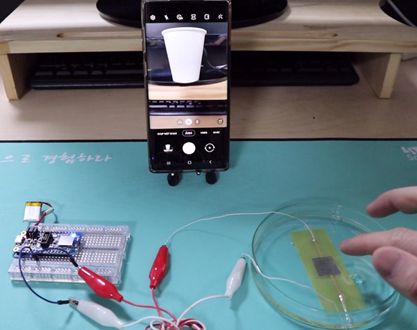
TSUKUBA, Japan, Aug 18, 2021 – (ACN Newswire) – Flexible and waterproof sensors that could unlock new applications for wearable electronics have been developed by scientists in Korea. Published in the journal Science and Technology of Advanced Materials, the study shows how the pressure sensor can control a phone, to take photos and play music, even when the sensor is fully immersed in water.
 |
The technology could transform the use of wearable electronics in healthcare, smart textiles and for specific applications including scuba diving equipment, say the study researchers, who are based at Soongsil University in Seoul.
"Flexible electronics will usher in a whole new world of wearable technologies to monitor our health and lifestyles," says Jooyong Kim, a materials scientist who led the research. "But until now, many of these applications have been held back because the pressure sensors they rely on could not handle being exposed to water. We have changed that."
To demonstrate the power of the new technology, the researchers incorporated one of the sensors into a flexible face mask. Sensitive enough to detect the movement of air inside the mask, the sensor could track and report the rate of breathing of a wearer in real-time.
The sensor converts tiny movements caused by change in pressure and electrical resistance into electronic signals. Like many similar flexible electronic devices, the design of the circuit was hand-drawn onto a conducting material with a marker-pen, which acts to shield the circuitry when the rest of the material was etched away. This is cheaper than traditional methods.
The researchers then mounted the finger-print sized circuit onto a blend of wet tissue paper and carbon nanotubes, which works to detect changes in pressure. They then covered the layered sensor device with a strip of tape, to make it waterproof.
The device can track both the magnitude and location of pressure applied to it. Using machine learning technology to process the signals, the researchers found the sensors could feel and report applied pressures in the lab with up to 94% accuracy. And by connecting the sensor to a wi-fi network, the researchers could press it underwater to control phone functions, including double touch, triple touch, short touch, and long touch patterns.
"We expect the readily-available materials, easy fabrication techniques, and machine learning algorithms we have demonstrated in this journal article will bring significant contributions to the development of hand-drawn sensors in the future," says Kim.
Further information
Jooyong Kim
Soongsil University
Email: jykim@ssu.ac.kr
Paper: https://www.tandfonline.com/doi/full/10.1080/14686996.2021.1961100
About Science and Technology of Advanced Materials (STAM)
Open access journal STAM publishes outstanding research articles across all aspects of materials science, including functional and structural materials, theoretical analyses, and properties of materials. https://www.tandfonline.com/STAM
Dr. Yoshikazu Shinohara
STAM Publishing Director
Email: SHINOHARA.Yoshikazu@nims.go.jp
Press release distributed by Asia Research News for Science and Technology of Advanced Materials.
Copyright 2021 ACN Newswire. All rights reserved. http://www.acnnewswire.com
Hydrogel holds life-giving cells longer
TSUKUBA, Japan, Aug 6, 2021 – (ACN Newswire) – Heart muscle becomes damaged and cardiac function is affected when blood vessels feeding the heart are blocked. A new stem-cell-carrying hydrogel helps mice recover from this condition, called myocardial infarction, by stimulating formation of new blood vessels. Developed by a team of scientists at Kansai University in Japan, the stem cell delivery system is described in the journal Science and Technology of Advanced Materials.
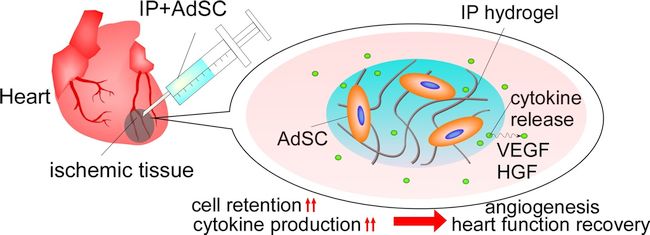 |
The team used stem cells derived from fat tissue in their application. These so-called 'adipose-derived stem cells' have already been investigated for treating damaged cardiac tissue from reduced blood flow to the heart, known as myocardial ischemia. The idea is that the stem cells will release stimulating factors to regenerate blood vessels once injected into damaged heart tissue. The problem, though, is that they can't be retained or survive in the tissue long enough. In other studies, scientists have found that injecting cell-free biodegradable hydrogels into damaged heart tissue helps partial recovery of heart functions.
Kansai University bioengineer Yuichi Ohya and his colleagues mixed the two techniques together.
Firstly, they developed hydrogel formulas that can hold stem cells in place for longer periods of time at the site of tissue damage. These hydrogels start off as a solution when they are at room temperature. This makes it easy to mix in the stem cells. When the solution is injected into an organ, it warms to body temperature, triggering its transformation into a gel.
One of their hydrogels was especially good at staying in its gel state. It was made with a combination of molecules, called tri-PCG, with acrolyl groups attached to them. The tri-PCG-acryl was then mixed with a polythiol derivative.
The team added adipose-derived stem cells to the hydrogel and observed, both in petri dishes and inside mouse heart tissue, how long the cells lived and what kinds of genes and substances were produced by the cells.
"The stem cells were able to survive in our injectable hydrogel and released molecules that stimulate blood vessel formation, improving heart function and making it effective for treatment of ischemic heart," says Ohya.
The team next plans to test their therapy on larger animals after confirming its safety, and then to conduct clinical studies in humans. They also plan to investigate using their injectable hydrogel to deliver immune cells to treat cancer or in vaccines to protect against viral infections.
Further information
Yuichi Ohya
Kansai University
Email: yohya@kansai-u.ac.jp
Paper: https://www.tandfonline.com/doi/full/10.1080/14686996.2021.1938212%40tsta20.2021.22.issue-BioJ
About Science and Technology of Advanced Materials Journal
Open access journal STAM publishes outstanding research articles across all aspects of materials science, including functional and structural materials, theoretical analyses, and properties of materials. https://www.tandfonline.com/STAM
Dr. Yoshikazu Shinohara
STAM Publishing Director
Email: SHINOHARA.Yoshikazu@nims.go.jp
Press release distributed by ResearchSEA for Science and Technology of Advanced Materials.
Copyright 2021 ACN Newswire. All rights reserved. http://www.acnnewswire.com
 theacnnewswire.news.blog