
TANAKA Establishes Production System in China for Fuel Cell Electrode Catalysts

TOKYO, Sep 12, 2023 – (ACN Newswire) – TANAKA Kikinzoku Kogyo K.K. (Head office: Chiyoda-ku, Tokyo; Group CEO: Koichiro Tanaka), which operates an industrial precious metals business as a core company of TANAKA Precious Metals, announced today that it has signed a technical assistance agreement with Chengdu Guangming Paite Precious Metal Co., Ltd., an affiliated company in China, in the area of fuel cell electrode catalyst manufacturing technologies.
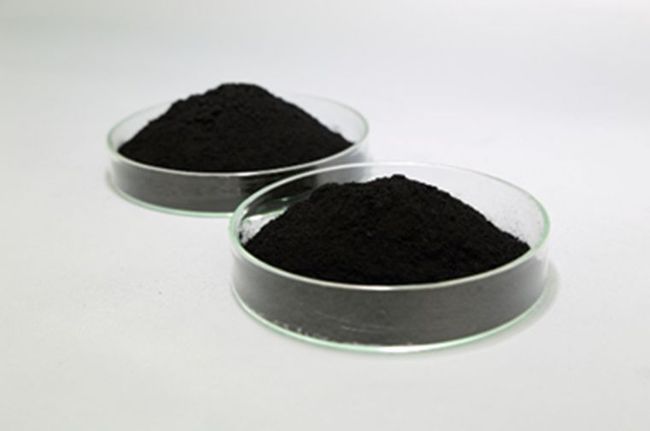

Electrode catalysts for polymer electrolyte membrane fuel cells (PEFCs)


As part of the agreement, production equipment will be installed at the plant of Ya'an Guangming Paite Precious Metal Co., Ltd., a subsidiary of Chengdu Guangming Paite Precious Metal, with plans to start full-scale production in the summer of 2024. The companies also plan to start production of fuel cell electrode catalysts for the Chinese market by the end of 2025. As a member of TANAKA and with the leading share of the global market for fuel cell electrode catalysts, TANAKA Kikinzoku Kogyo aims to use this agreement to meet the growing domestic demand for fuel cell electrode catalysts in China.

TANAKA's Fuel Cell Electrode Catalysts

TANAKA's FC Catalyst Development Center, within its Shonan Plant, is currently developing and manufacturing electrode catalysts for polymer electrolyte membrane fuel cells (PEFCs) and polymer electrolyte water electrolysis (PEWE). The company sells highly active, highly durable platinum catalysts and platinum alloy catalysts for PEFC cathodes[1], highly CO-tolerant platinum alloy catalysts and OER catalysts[2] for PEFC anodes[3], and iridium oxide catalysts for PEWE anodes.

PEFCs are used in applications such as fuel cell vehicles (FCVs) and residential-use fuel cells (ENE-FARM), with their use expected to expand in the future to also include buses, trucks, and other commercial vehicles, forklifts and other material handling vehicles, heavy construction machines, robots and other industrial machines, and large stationary equipment. Compact, lightweight, high-output PEFCs employ a chemical reaction between hydrogen and oxygen to generate power, which will make them important devices for the global environment of the future.

One major issue facing the full-scale use of fuel cell batteries is the cost of the platinum they use. TANAKA has been researching precious metal catalysts for more than 40 years, resulting in the development of catalysts that use smaller amounts of precious metals while achieving high performance and high durability. By studying new carrier materials and catalyst post-processing methods and producing more active metal species, the company is currently developing catalysts that are even more suitable for use in fuel cells.

Trends in the Global Fuel Cell Market

In China, government policy continues to drive the development of hydrogen energy and FCVs as strategic industries. The Chinese government is implementing a range of support measures to promote research and development and the expanded use of fuel cell battery technologies. It is also driving the development and adoption of FCVs through subsidies, tax incentives, and other efforts. With other measures, including the development of hydrogen supply infrastructure in cities and along major traffic routes, the country's fuel cell market is expected to grow even further going forward.

In Europe and the United States as well, governments are promoting zero-emission vehicles (ZEVs)[4]. In the EU, as part of the Fit for 55 package of climate change measures adopted by the European Union in April 2023, a bill was adopted to require new passenger vehicles and small commercial vehicles to be zero-emission, in principle, from 2035. (The sale of new vehicles equipped with internal combustion engines will only be accepted after 2035 if they use synthetic fuels (e-fuels)[5].) In the US as well, an executive order was issued in 2021 to require 50% of new car sales to be electric by 2030.

In Japan, the Ministry of Economy, Trade, and Industry has been meeting with representatives of the hydrogen supply industry, automobile manufacturers, logistics companies, local governments, and others since September 2022 to discuss the expanded use of hydrogen in mobility. In an interim summary of discussions in July 2023, it announced that the selection of priority areas for early adoption of trucks and buses that use fuel cells to run will be finalized before the end of this year.

TANAKA will continue to focus on research and development while working to achieve stable supplies of fuel cell electrode catalysts, and as the leading company in the area of fuel cell electrode catalysts, it aims to contribute toward the expansion of fuel cell use and realization of a hydrogen society.

[1] Cathodes: Hydrogen-generation electrodes (air poles) where oxygen reduction reactions take place. This assumes that hydrogen-generation electrodes are being used for water electrolysis (PEWE).

[2] OER catalysts: Catalysts that activate oxygen evolution reactions.

[3] Anodes: Oxygen-generation electrodes (fuel poles) where hydrogen oxidation reactions take place. This assumes that hydrogen-generation electrodes are being used for water electrolysis (PEWE).

[4] Zero-emission vehicles: Electric vehicles (EVs) and fuel cell vehicles (FCVs) that emit no carbon dioxide or other greenhouse gases during operation. In the United States, plug-in electric vehicles (PHEVs) are also considered to be ZEVs.

[5] E-fuels: Petroleum-alternative fuels produced in a chemical reaction between carbon dioxide (CO2) and hydrogen (H2).

About TANAKA Precious Metals

Since its foundation in 1885, TANAKA Precious Metals has built a portfolio of products to support a diversified range of business uses focused on precious metals. TANAKA is a leader in Japan regarding the volumes of precious metals handled. Over the course of many years, TANAKA has not only manufactured and sold precious metal products for industry but also provided precious metals in such forms as jewelry and assets. As precious metals specialists, all Group companies in Japan and around the world collaborate and cooperate on manufacturing, sales, and technology development to offer a full range of products and services. With 5,355 employees, the group's consolidated net sales for the fiscal year ending March 31, 2023, was 680 billion yen.

Global industrial business website
https://tanaka-preciousmetals.com/en/

Product inquiries
TANAKA Kikinzoku Kogyo K.K.
https://tanaka-preciousmetals.com/en/inquiries-on-industrial-products/

Press inquiries
TANAKA Holdings Co., Ltd.
https://tanaka-preciousmetals.com/en/inquiries-for-media/

Press Release: http://www.acnnewswire.com/docs/files/20230912_EN.pdf

Copyright 2023 ACN Newswire. All rights reserved. http://www.acnnewswire.com

Face-down: Gravity’s effects on cell movement

TSUKUBA, Japan, May 13, 2023 – (ACN Newswire) – Researchers at the National Institute for Materials Science (NIMS) and colleagues in Japan have developed a specially coated, light-responsive surface that helps test how the direction of gravity impacts cell movements. The findings, published in the journal Science and Technology of Advanced Materials, could lead to a better understanding of what happens to cells in people who are bedridden for prolonged periods and of the impact of gravity's direction on cancer cell migration.


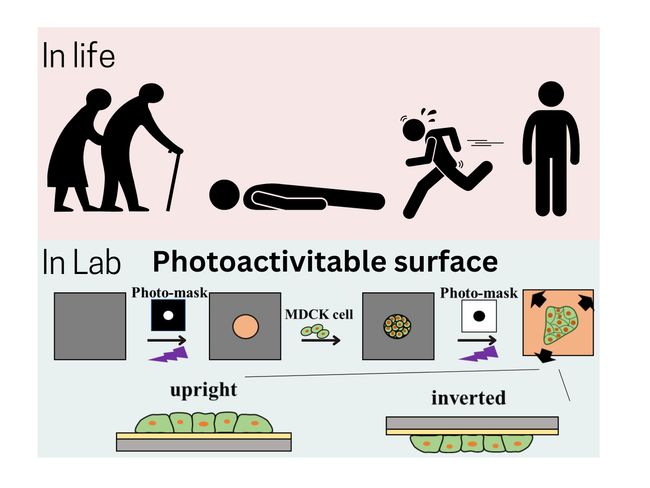
The human body takes many different positions over its lifespan. Scientists wanted to find a way
to study how cell movement is impacted when the direction of gravity changes as our body positions
change. (Image created using materials from STAM Vol.24, Issue 1, Article 2206525 (2023) and
Canva.)


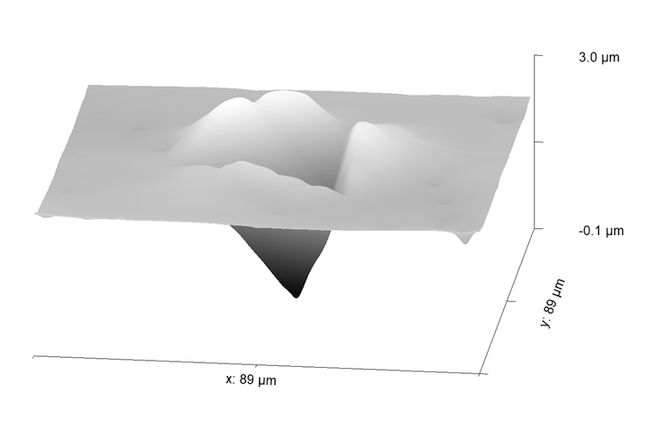
The special surfaces are made by coating glass slides with a combination of molecules that are responsive to light. Shining light on a central, circular area of the slide breaks up the molecules, clearing away a coating-free zone that cells can stick to. Once stabilized in this area, the scientists then use light to clear away an area surrounding the central circle. This encourages the cells to move in an outward direction to fill the square. The team investigated what happens to cell movement when the slide is placed upright, with the cells lying on top and the direction of gravity impacting the cells from top to bottom. They then conducted a similar test with the slide flipped over while supported on either side so that the cells are inverted and the direction of gravity is from the bottom of the cells to their tops.

"We found that the direction of gravity hindered collective cell migration in the inverted position by reducing the number of outward-moving leader cells at cluster edges and by redistributing shape-forming filaments, composed of actin and myosin, so that they kept the cells bundled together," explains biomaterials researcher, Shimaa Abdellatef, who is a postdoc at NIMS.

The coated, light-responsive surfaces provide an advantage over currently available methods that study the impacts of gravity's direction, as they require physical contact with the surface to which cells are attached. The new approach enables remote induction of cell migration.

"We plan to apply our approach to analyse the responses of cancer cells to the direction of gravity," says NIMS nanoscientist, Jun Nakanishi, who led the study. "We expect to find differences between healthy and diseased cells, which could provide important information about cancer progression in bedridden patients."

Further information
Jun Nakanishi
National Institute for Materials Science (NIMS)
Email:NAKANISHI.Jun@nims.go.jp

Shimaa A. Abdellatef
National Institute for Materials Science (NIMS)
Email: ABDELALEEM.shimaa@nims.go.jp

Paper: https://doi.org/10.1080/14686996.2023.2206525

About Science and Technology of Advanced Materials (STAM)

Open access journal STAM publishes outstanding research articles across all aspects of materials science, including functional and structural materials, theoretical analyses, and properties of materials. https://www.tandfonline.com/STAM

Dr Yasufumi Nakamichi
STAM Publishing Director
Email: NAKAMICHI.Yasufumi@nims.go.jp

Press release distributed by Asia Research News for Science and Technology of Advanced Materials.

Copyright 2023 ACN Newswire. All rights reserved. http://www.acnnewswire.com
New data extracted from old for materials databases

TSUKUBA, Japan, Nov 7, 2022 – (ACN Newswire) – A new approach uses data from one type of test on small metal alloy samples to extract enough information for building databases that can be used to predict the properties and potentials of new materials. The details were published in the journal Science and Technology of Advanced Materials: Methods.


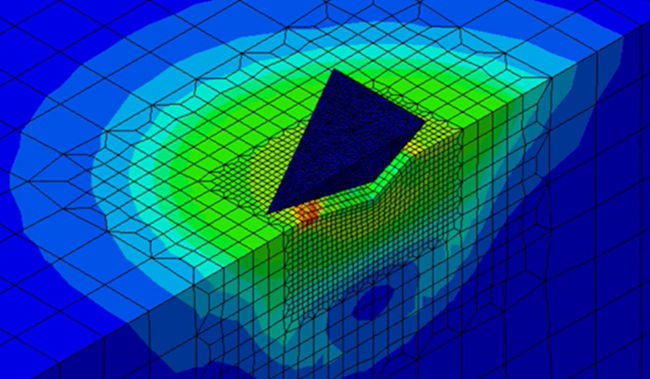
The scientists used computer simulations to build database of material properties.

The Scientists found a way to use topography around indentation impression to predict other properties measured by a tensile or compression test.


The test is called instrumented indentation. It involves driving an indenter tip into a material to probe some of its properties, such as hardness and elastic stiffness. Scientists have been using the data extracted from instrumented indentation to estimate the stress-strain curve of materials using computational simulations. This curve, and the data it provides, is important for understanding a material's properties. That data is also used for building massive materials databases, which can be used, in conjunction with artificial intelligence, for predicting new materials.

A problem scientists face is that this approach for estimating material properties is limited when it comes to materials called 'high work-hardening alloys': metal alloys, like steel, that are strengthened through physical processes like rolling and forging. Only so much information can be estimated from the curve of these materials. To get the necessary additional information needed to determine their properties, more experiments would need to be done, which costs time, effort and money.

Ta-Te Chen of the University of Tsukuba and Ikumu Watanabe of the National Institute for Materials Science in Japan have developed a new computational approach to extract that additional information from instrumented indentation tests on work-hardening alloys.

"Our approach builds on an already-existing model, making it ready for use in industry. It is also applicable to existing data, including hardness," says Watanabe.

The approach involves combining the results from two computational models, the power-law and linear hardening models, which produce their own individual stress-plastic strain curves from information gathered from indentation tests. Combining the data from both curves provides the extra data that, when added to the original stress-strain curve, shows a more holistic picture of the work-hardening alloys' properties.

The scientists validated their approach by using it on a high-work-hardening stainless steel.

We have extended this approach to also evaluate mechanical properties at elevated temperatures, which can contribute to the development of high-temperature alloys," says Chen.

Further information
Ikumu Watanabe
National Institute for Materials Science
Email: WATANABE.Ikumu@nims.go.jp

About Science and Technology of Advanced Materials: Methods (STAM Methods)

STAM Methods is an open access sister journal of Science and Technology of Advanced Materials (STAM), and focuses on emergent methods and tools for improving and/or accelerating materials developments, such as methodology, apparatus, instrumentation, modeling, high-through put data collection, materials/process informatics, databases, and programming. https://www.tandfonline.com/STAM-M

Dr. Yasufumi Nakamichi
STAM Methods Publishing Director
Email: NAKAMICHI.Yasufumi@nims.go.jp

Press release distributed by Asia Research News for Science and Technology of Advanced Materials.

Copyright 2022 ACN Newswire. All rights reserved. http://www.acnnewswire.com
Windows gain competitive edge over global warming

TSUKUBA, Japan, Sep 1, 2022 – (ACN Newswire) – A French-Japanese research collaboration has fabricated metal nanocomposite coatings that improve the insulating properties of window glasses. The new coating prevents a significant portion of near-infrared (NIR) and ultraviolet rays (UV) from passing through, while at the same time admitting visible light. The findings were reported in the journal Science and Technology of Advanced Materials.


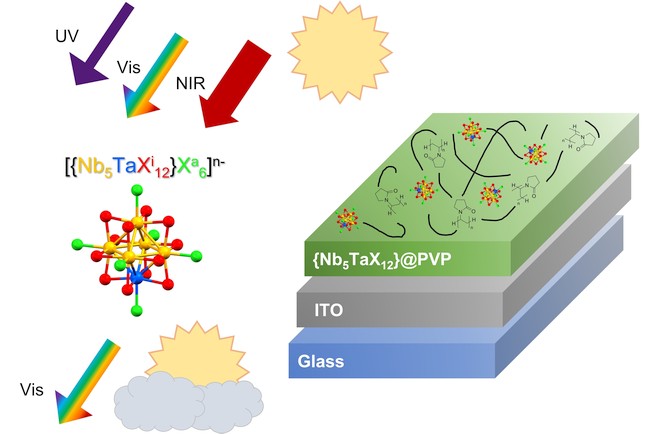
The nanoclusters are dispersed in a PVP matrix that is then coated on ITO glass to block NIR and UV rays while letting visible light pass through.


"Although the fabrication of a commercial products is still a long way ahead, our work demonstrated a significant improvement in UV and NIR blocking properties compared to previous research," says solid-state chemist Fabien Grasset, research director at the French National Centre for Scientific Research (CNRS).

"Buildings account for a large part of global energy consumption," explains Grasset, "with a large amount of the annual energy consumption of a standard building going to cooling and/or heating systems to maintain indoor temperatures at comfortable levels." Scientists are looking for ways to develop window glass coatings that can block the entry of NIR radiation so that buildings, and even cars, can consume less energy to keep it cool inside. However, this needs to be done in a way that still allows visible light to enter. Ideally, harmful UV rays would also be blocked.

To this end, the international French-Japanese research collaboration fabricated and analysed the performance of nanocomposites based on niobium-tantalum cluster compounds containing chloride or bromide ions.

They found that chloride-based nanoclusters provided the best performance in terms of blocking NIR and UV rays and allowing the passage of visible light. NIR and UV blocking by the nanoclusters depended on their concentration, dispersion and oxidation state. By tuning these parameters, the team was able to improve the nanocluster performance.

The nanoclusters were dispersed into a polyvinylpyrrolidone (PVP) matrix that was then coated onto indium-tin-oxide (ITO) glass. The combination increased the transmittance of visible light while reducing that of NIR and UV rays, relative to previous research. "These are very promising coating materials that block the most troublesome NIR wavelengths," says Grasset.

"We have a long history of Japanese-French collaboration," he continues. "We were already convinced that we are stronger working together by mixing our different cultures and ways of thinking. The international LINK project has reinforced this belief. We will continue to do our best to make further progress towards finding solutions for the global warming problem."

Further information
Fabien Grasset
French National Centre for Scientific Research (CNRS)
Email: fabien.grasset@cnrs.fr

Research paper: https://www.tandfonline.com/doi/full/10.1080/14686996.2022.2105659

About Science and Technology of Advanced Materials (STAM)

Open access journal STAM publishes outstanding research articles across all aspects of materials science, including functional and structural materials, theoretical analyses, and properties of materials. https://www.tandfonline.com/STAM

For more information on STAM, contact
Dr. Mikiko Tanifuji
STAM Publishing Director
Email: TANIFUJI.Mikiko@nims.go.jp

Press release distributed by Asia Research News for Science and Technology of Advanced Materials.

Copyright 2022 ACN Newswire. All rights reserved. http://www.acnnewswire.com
A new age of 2.5D materials

TSUKUBA, Japan, May 6, 2022 – (ACN Newswire) – Scientists are exploring new ways to artificially stack two-dimensional (2D) materials, introducing so-called 2.5D materials with unique physical properties. Researchers in Japan reviewed the latest advances and applications of 2.5D materials in the journal Science and Technology of Advanced Materials.


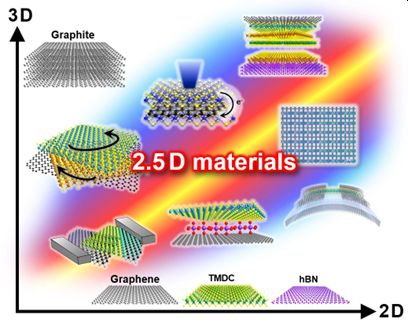
By stacking layers of different 2D materials, it is now possible to create 2.5D materials with unique physical properties that can be used in solar cells, quantum devices and devices with very low energy consumption. (Credit: STAM)


"The 0.5D concept symbolizes freedom from the composition, materials, angles and space typically used in 2D materials research," explains nanomaterials scientist and lead author Hiroki Ago of Kyushu University in Japan.

2D materials, like graphene, consist of a single layer of atoms and are used in applications like flexible touch panels, integrated circuits and sensors.

Recently, new methods have been introduced to make it possible to artificially stack 2D materials vertically, in-plane or at twisted angles regardless of their compositions and structures. This is thanks to the ability to control the van der Waals forces: weak electric interactions between atoms and molecules, similar to a microfiber cloth's attraction of dust. It is also now possible to integrate 2D materials with other dimensional materials, such as ions, nanotubes and bulk crystals.

A common method for fabricating 2.5D materials is chemical vapour deposition (CVD), which deposits a layer, one atom or molecule at a time, onto a solid surface. Commonly used building blocks for 2.5D materials include graphene, hexagonal boron nitride (hBN) (a compound used in cosmetics and aeronautics), and transition metal dichalcogenides (TMDCs) (a nanosheet semiconductor).

Using the CVD method, researchers selectively synthesized a bilayer of graphene, the simplest form of a 2.5D material, using a copper-nickel foil with relatively high nickel concentration as a catalyst. Nickel makes carbon highly soluble, giving researchers more control over the number of graphene layers. When an electrical field was applied vertically across the bilayer of graphene, it opened a band gap, meaning that its conductivity can be turned on and off. This is a phenomenon that is not observed in monolayer graphene because it has no band gap and stays on all the time. By tilting the stacking angle one degree, scientists found that the material became superconducting.

Similarly, another group in the UK and the US found that a layer of graphene and hBN results in the quantum Hall effect, a conduction phenomenon involving a magnetic field that produces a difference of potential. Others showed that stacking TMDCs traps excitons (electrons paired with their associated holes in a bound state) in the overlapping lattice patterns. This can lead to applications in information storage devices. New robotic assembly techniques have also made it possible to build more complex vertical structures, including a stacked heterostructure consisting of 29 alternating layers of graphene and hBN, for example.

Other research has used the nanospaces that form between the layers of a 2.5D material to insert molecules and ions in order to improve the electrical, magnetic and optical properties of the host material.

So far, for example, researchers have found that graphene stabilises iron chloride when it is inserted between its stacked layers, while inserting lithium ions leads to a faster diffusion rate (how quickly molecules spread in an area) than that of graphite, an electrical conductor used in batteries. This implies the material could be used in high-performance rechargeable batteries.

Additionally, researchers found that inserting aluminium chloride molecules between two graphene sheets leads to the formation of new crystalline structures that are completely different from the bulk aluminium chloride crystal. More research is needed to understand why this happens and what applications it might have.

"There are many opportunities to explore with this new 2.5D concept," Ago says.

Future applications of 2.5D materials include solar cells, batteries, flexible devices, quantum devices, and devices with very low energy consumption.

The next steps should incorporate machine learning, deep learning and materials informatics in order to further advance the design and synthesis of 2.5D materials.

Japan's Ministry of Education, Culture, Sports, Science and Technology is now supporting this new concept to develop new materials under the collaborative project "Science of 2.5 Dimensional Materials: Paradigm Shift of Materials Science Toward Future Social Innovation", which involves 40 researchers in Japan, including Ago's team.

Further information
Hiroki Ago
Kyushu University
Email: ago.hiroki.974@m.kyushu-u.ac.jp

Research paper: https://www.tandfonline.com/doi/full/10.1080/14686996.2022.2062576

About Science and Technology of Advanced Materials (STAM)

Open access journal STAM publishes outstanding research articles across all aspects of materials science, including functional and structural materials, theoretical analyses, and properties of materials. https://www.tandfonline.com/STAM

Dr. Masanobu Naito
STAM Publishing Director
Email: NAITO.Masanobu@nims.go.jp

Press release distributed by Asia Research News for Science and Technology of Advanced Materials.

Copyright 2022 ACN Newswire. All rights reserved. http://www.acnnewswire.com
Submerged sensors to control wearable electronics

TSUKUBA, Japan, Aug 18, 2021 – (ACN Newswire) – Flexible and waterproof sensors that could unlock new applications for wearable electronics have been developed by scientists in Korea. Published in the journal Science and Technology of Advanced Materials, the study shows how the pressure sensor can control a phone, to take photos and play music, even when the sensor is fully immersed in water.


Scientists in Korea have developed a pressure sensor that can control a cell phone from underwater


The technology could transform the use of wearable electronics in healthcare, smart textiles and for specific applications including scuba diving equipment, say the study researchers, who are based at Soongsil University in Seoul.

"Flexible electronics will usher in a whole new world of wearable technologies to monitor our health and lifestyles," says Jooyong Kim, a materials scientist who led the research. "But until now, many of these applications have been held back because the pressure sensors they rely on could not handle being exposed to water. We have changed that."

To demonstrate the power of the new technology, the researchers incorporated one of the sensors into a flexible face mask. Sensitive enough to detect the movement of air inside the mask, the sensor could track and report the rate of breathing of a wearer in real-time.

The sensor converts tiny movements caused by change in pressure and electrical resistance into electronic signals. Like many similar flexible electronic devices, the design of the circuit was hand-drawn onto a conducting material with a marker-pen, which acts to shield the circuitry when the rest of the material was etched away. This is cheaper than traditional methods.

The researchers then mounted the finger-print sized circuit onto a blend of wet tissue paper and carbon nanotubes, which works to detect changes in pressure. They then covered the layered sensor device with a strip of tape, to make it waterproof.

The device can track both the magnitude and location of pressure applied to it. Using machine learning technology to process the signals, the researchers found the sensors could feel and report applied pressures in the lab with up to 94% accuracy. And by connecting the sensor to a wi-fi network, the researchers could press it underwater to control phone functions, including double touch, triple touch, short touch, and long touch patterns.

"We expect the readily-available materials, easy fabrication techniques, and machine learning algorithms we have demonstrated in this journal article will bring significant contributions to the development of hand-drawn sensors in the future," says Kim.

Further information
Jooyong Kim
Soongsil University
Email: jykim@ssu.ac.kr

Paper: https://www.tandfonline.com/doi/full/10.1080/14686996.2021.1961100

About Science and Technology of Advanced Materials (STAM)

Open access journal STAM publishes outstanding research articles across all aspects of materials science, including functional and structural materials, theoretical analyses, and properties of materials. https://www.tandfonline.com/STAM

Dr. Yoshikazu Shinohara
STAM Publishing Director
Email: SHINOHARA.Yoshikazu@nims.go.jp

Press release distributed by Asia Research News for Science and Technology of Advanced Materials.

Copyright 2021 ACN Newswire. All rights reserved. http://www.acnnewswire.com
Using AI to predict new materials with desired properties

Tsukuba, Japan, Aug 1, 2020 – (ACN Newswire) – Scientists in Japan have developed a machine learning approach that can predict the elements and manufacturing processes needed to obtain an aluminum alloy with specific, desired mechanical properties. The approach, published in the journal Science and Technology of Advanced Materials, could facilitate the discovery of new materials.


Aluminum alloys are lightweight, energy-saving materials which are used for various purposes, from welding materials for buildings to bicycle frames. (Credit: Jozef Polc via123rf)


Aluminum alloys are lightweight, energy-saving materials made predominantly from aluminum, but also contain other elements, such as magnesium, manganese, silicon, zinc and copper. The combination of elements and manufacturing process determines how resilient the alloys are to various stresses. For example, 5000 series aluminum alloys contain magnesium and several other elements and are used as a welding material in buildings, cars, and pressurized vessels. 7000 series aluminum alloys contain zinc, and usually magnesium and copper, and are most commonly used in bicycle frames.

Experimenting with various combinations of elements and manufacturing processes to fabricate aluminum alloys is time-consuming and expensive. To overcome this, Ryo Tamura and colleagues at Japan's National Institute for Materials Science and Toyota Motor Corporation developed a materials informatics technique that feeds known data from aluminum alloy databases into a machine learning model. This trains the model to understand relationships between alloys' mechanical properties and the different elements they are made of, as well as the type of heat treatment applied during manufacturing. Once the model is provided enough data, it can then predict what is required to manufacture a new alloy with specific mechanical properties. All this without the need for input or supervision from a human.

The model found, for example, 5000 series aluminum alloys that are highly resistant to stress and deformation can be made by increasing the manganese and magnesium content and reducing the aluminum content. "This sort of information could be useful for developing new materials, including alloys, that meet the needs of industry," says Tamura.

The model employs a statistical method, called Markov chain Monte Carlo, which uses algorithms to obtain information and then represent the results in graphs that facilitate the visualization of how the different variables relate. The machine learning approach can be made more reliable by inputting a larger dataset during the training process.

Further information
Ryo Tamura
National Institute for Materials Science
tamura.ryo@nims.go.jp

Paper: https://doi.org/10.1080/14686996.2020.1791676

About Science and Technology of Advanced Materials Journal

Open access journal STAM publishes outstanding research articles across all aspects of materials science, including functional and structural materials, theoretical analyses, and properties of materials.

Chikashi Nishimura
STAM Publishing Director
NISHIMURA.Chikashi@nims.go.jp

Press release distributed by ResearchSEA for Science and Technology of Advanced Materials.

Copyright 2020 ACN Newswire. All rights reserved. http://www.acnnewswire.com

Let the robot swarms begin!

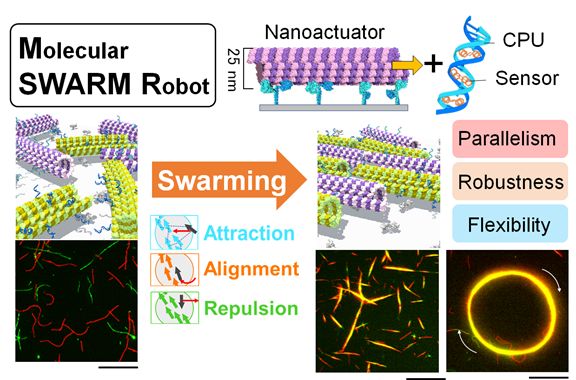
Scientists are looking for ways to make millions of molecule-sized robots swarm together so they can perform multiple tasks simultaneously.

Tsukuba, Japan, June 19, 2020 – (ACN Newswire) – Multi-disciplinary research has led to the innovative fabrication of molecule-sized robots. Scientists are now advancing their efforts to make these robots interact and work together in the millions, explains a review in the journal Science and Technology of Advanced Materials.

“Molecular robots are expected to greatly contribute to the emergence of a new dimension in chemical synthesis, molecular manufacturing, and artificial intelligence,” writes Hokkaido University physical chemist Dr. Akira Kakugo and his colleagues in their review.

Rapid progress has been made in recent years to build these tiny machines, thanks to supramolecular chemists, chemical and biomolecular engineers, and nanotechnologies, among others, working closely together. But one area that still needs improvement is controlling the movements of swarms of molecular robots, so they can perform multiple tasks simultaneously.

Towards this end, researchers have made molecular robots with three key components: microtubules, single-stranded DNA, and a light-sensing chemical compound. The microtubules act as the molecular robot’s motor, converting chemical energy into mechanical work. The DNA strands act as the information processor due to its incredible ability to store data and perform multiple functions simultaneously. The chemical compound, azobenzene derivative, is able to sense light, acting as the molecular robot’s on/off switch.

Scientists have made huge moving ‘swarms’ of these molecular robots by utilizing DNA’s ability to transmit and receive information to coordinate interactions between individual robots. See the video below.

Scientists have devised a new method of using DNA to control molecular robots. Molecules swarm like a flock of birds, showing different patterns of movement when this method is applied. (Copyright: Hokkaido University)

Scientists have successfully controlled the shape of those swarms by tuning the length and rigidity of the microtubules. Relatively stiff robots swarm in uni-directional, linear bundles, while more flexible ones form rotating, ring-shaped swarms.

A continuing challenge, though, is making separate groups of robots swarm at the same time, but in different patterns. This is needed to perform multiple tasks simultaneously. One group of scientists achieved this by designing one DNA signal for rigid robots, sending them into a unidirectional bundle-shaped swarm, and another DNA signal for flexible robots, which simultaneously rotated together in a ring-shaped swarm.

Light-sensing azobenzene has also been used to turn swarms off and on. DNA translates information from azobenzene when it senses ultraviolet light, turning a swarm off. When the azobenzene senses visible light, the swarm is switched back to on state.

“Robot sizes have been scaled down from centimeters to nanometers, and the number of robots participating in a swarm has increased from 1,000 to millions,” write the researchers. Further optimization is still necessary, however, to improve the processing, storing and transmitting of information. Also, issues related to energy efficiency and reusability, in addition to improving the lifetime of molecular robots, still need to be addressed.

Further information

Akira Kakugo
Hokkaido University
kakugo@sci.hokudai.ac.jp
Paper: https://doi.org/10.1080/14686996.2020.1761761

About Science and Technology of Advanced Materials Journal

Open access journal STAM publishes outstanding research articles across all aspects of materials science, including functional and structural materials, theoretical analyses, and properties of materials.

Chikashi Nishimura
STAM Publishing Director
NISHIMURA.Chikashi@nims.go.jp
Image and caption:

A molecular robot, which is typically between 100 nanometers to 100 micrometers long, requires an actuator, processor and sensor to function properly. By fine-tuning their mutual interactions, millions of robots can move together in swarms that are much bigger in size than a single robot, offering several advantages. Scale bar: 20 μm. (Copyright: Akira Kakugo)

Press release distributed by ResearchSEA for Science and Technology of Advanced Materials.


Copyright 2020 ACN Newswire. All rights reserved. http://www.acnnewswire.com